













Covington & Slidell Independent Insurance Agents
Louisiana carpenter insurance protects finish carpenters from liability when property gets damaged on the job, covers tools and shop equipment against theft or loss, and pays medical costs for injuries like saw cuts or nail gun punctures. Most carpenters build this package through a local independent agency, such as one based in Covington or Slidell.
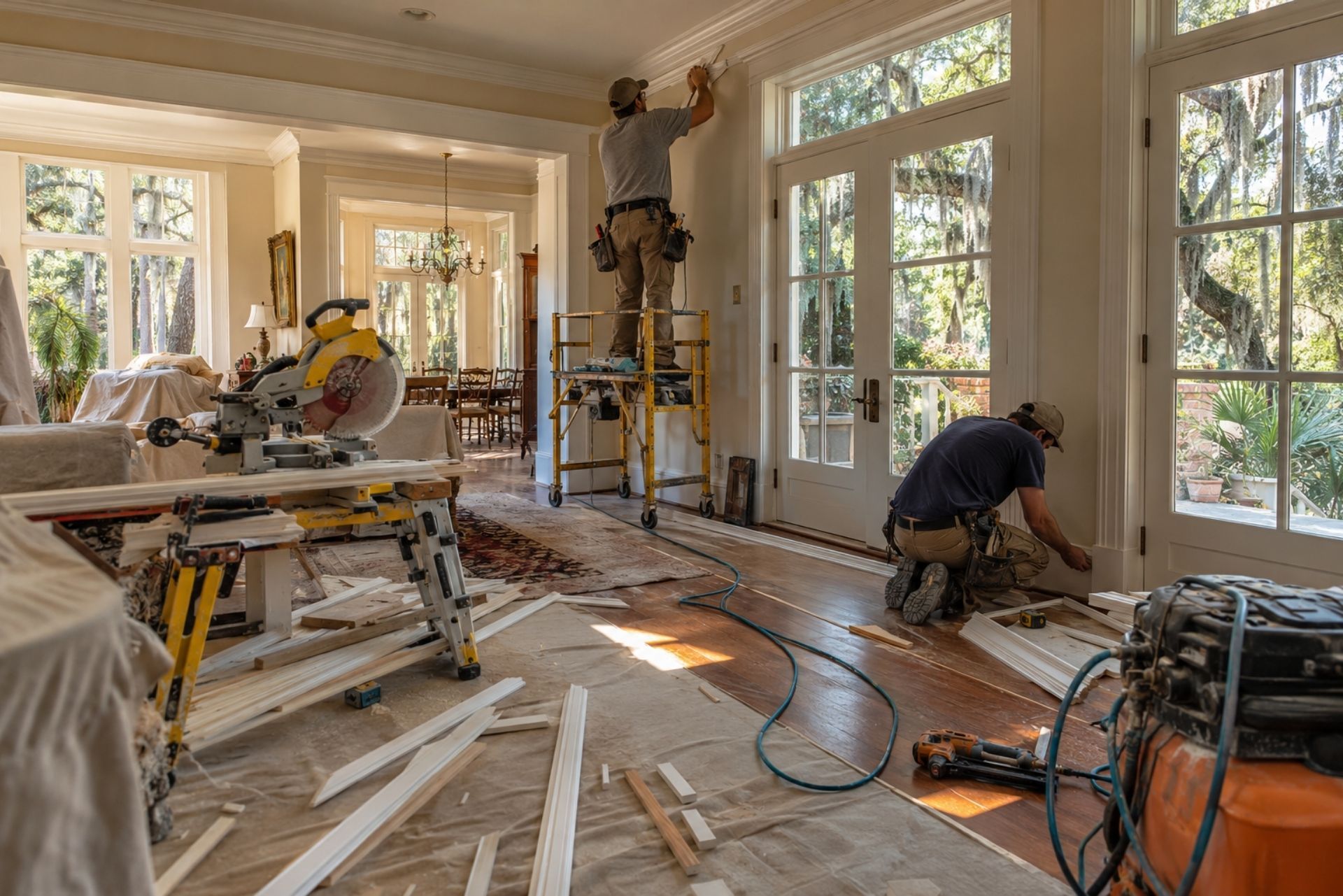
Picture a Tuesday afternoon in a Mandeville living room. You're coping crown molding while the homeowner's teenager plays video games ten feet away, the family dog keeps sniffing your miter saw stand, and a white oak floor stretches under your ladder. One slip, one cloud of MDF dust, or one dropped coil of trim can turn a profitable job into a claim. Finish carpentry sits in a strange middle ground. It's quieter and cleaner than framing, but you work inside finished, lived-in spaces where nearly everything around you costs money to replace.
Essential Insurance for Louisiana Finish Carpenters
Most finish carpenters in St. Tammany Parish need four core pieces of protection: general liability, workers' compensation if they have employees, tool and equipment coverage, and commercial auto for the truck or van hauling it all. Some also add shop property coverage if they run a cabinet or millwork space.
The rules got stricter this year. Effective August 1, 2026, Louisiana's Act 757 requires a minimum of $500,000 in liability insurance for all residential construction and home improvement contractors. That matters for anyone doing trim packages, built-ins, or cabinet installs in homes.
The law also gave the licensing board more teeth. The LSLBC can now suspend licenses when a contractor's insurance doesn't accurately reflect the work they perform. A common mistake we see is a policy classified as "carpentry, interior" for someone who also installs cabinets, builds decks, or does light remodeling. If your class codes don't match your actual jobs, you risk a denied claim and your license.

On this page
Aubert Insurance Agency is a local, independent agency, licensed to serve individuals and businesses across Louisiana, Mississippi, Florida and Texas.
We serve clients from our offices in Covington and Slidell and throughout St. Tammany Parish — working with dozens of carriers and wholesale markets to help homeowners, drivers, contractors, restaurant owners, property investors, auto shops, professional practices and many other personal and commercial clients find coverage that fits.
Licensed in Louisiana #3661 · Mississippi #15039075 · Florida #W0772236 · Texas #2381820
The jump from minimum limits to 100/300/100 often costs less than riders expect, because liability is typically priced per added layer rather than doubling with the limits. Ask for quotes at two or three levels side by side before you decide.
Here's a common scenario: you misjudge a curve and clip a late-model pickup, injuring the driver. A single ambulance ride, ER visit, and follow-up imaging can eat through $15,000 quickly. Anything above your limit can become your personal responsibility, which may put your savings, wages, or home at risk.
| Scenario | Dwelling limit | All-other-perils deductible | Named-storm deductible |
|---|---|---|---|
| Newer build, inland St. Tammany | $350,000 | $1,000 | 2% |
| Newer build, higher wind zone | $350,000 | $1,000 | 5% |
| Older home, updated roof | $275,000 | $2,500 | 2% |
| Older home, original roof | $275,000 | $2,500 | 5% |
| Fortified roof designation | $400,000 | $1,000 | 2% |
| Rebuilt after a prior claim | $400,000 | $2,500 | 5% |
| Bundled with auto | $350,000 | $1,000 | 2% |
Trim and Finish Work in Occupied Louisiana Homes
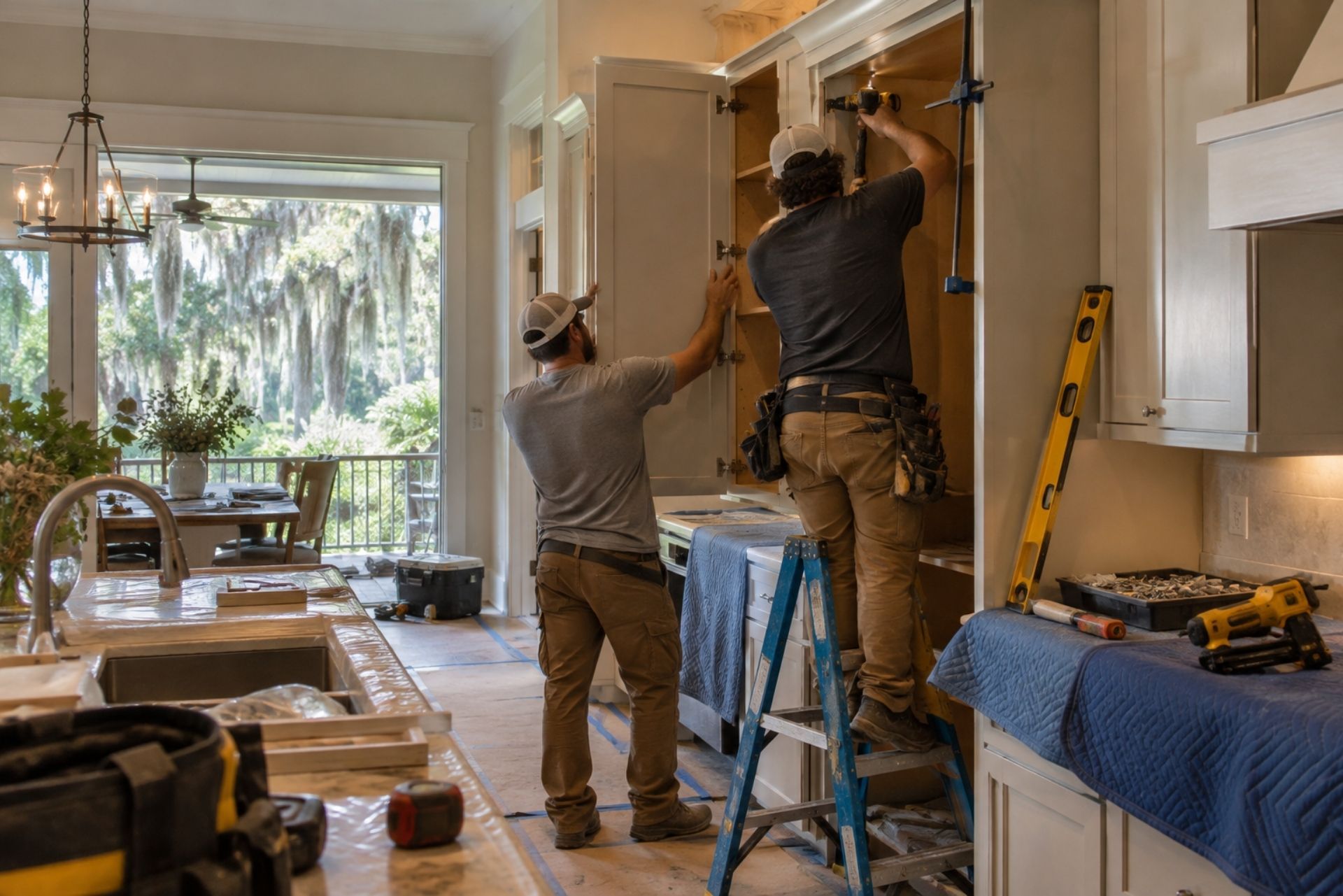
Working in an occupied home means working around everything the family owns. Framers rarely worry about a 75-inch TV. Finish carpenters do.
Here are the claim types that show up most often for trim and finish crews:
- Dust damage: Fine sanding dust and MDF particles can get into gaming consoles, audio receivers, computers, and HVAC returns. A homeowner may claim a dead laptop or a ruined air handler.
- Scratched floors: Dragging a ladder, dropping a chop saw, or kneeling with debris on your pads can gouge hardwood or luxury vinyl plank. Refinishing one room often means refinishing the connected rooms so the color matches.
- Wall and paint damage: Pulling old baseboard can tear drywall paper or crack plaster in older Covington homes.
- Trip and fall injuries: Cords, cutoffs, and nail strips left in a hallway can injure a homeowner or their guest.
General liability typically responds to third-party property damage and bodily injury caused by your work. If a ladder foot cracks a marble threshold, your GL policy may pay to repair it, subject to your deductible and policy terms.
The catch is the "your work" exclusion. GL generally won't pay to redo trim you installed poorly. It covers the damage your work causes to other property, not the cost of fixing your own workmanship. Knowing that distinction before a claim saves a lot of frustration.
With no lender to satisfy, the decision is yours, and so is the entire loss. A total rebuild in this parish runs well into six figures.
Homeowners who own outright
Your lender requires coverage at least equal to the loan, and will buy a policy on your behalf at your expense if yours lapses.
Homeowners with a mortgage
| Coverage Area | State Minimum | Common Higher Option | Stronger Option |
|---|---|---|---|
| Injury, one person | $15,000 | $50,000 | $100,000 |
| Injury, per accident | $30,000 | $100,000 | $300,000 |
| Property damage | $25,000 | $50,000 | $100,000 |
| Who it fits | Legal compliance only | Riders with modest assets | Homeowners, families, higher earners |
Here's a common scenario: you misjudge a curve and clip a late-model pickup, injuring the driver. A single ambulance ride, ER visit, and follow-up imaging can eat through $15,000 quickly. Anything above your limit can become your personal responsibility, which may put your savings, wages, or home at risk.
Minimum Coverage vs. Actual Protection Needs
The jump from minimum limits to 100/300/100 often costs less than riders expect, because liability is typically priced per added layer rather than doubling with the limits. Ask for quotes at two or three levels side by side before you decide.
Managing Risks of Saw and Nail Gun Injuries
Carpentry injuries cluster in two places: hands and eyes. Table saw kickback, a miter saw blade coasting down, or a brad nail ricocheting off a hidden screw can send someone to the emergency room fast.
Nail guns are a bigger problem than most people realize. Research shows that 40% of residential carpenter apprentices experience a nail gun injury during their first four years. That's two out of every five new hires on a typical crew.
The fix is simple and costs almost nothing in productivity. Sequential triggers may add roughly 10% to active nailing time but cut total project time by less than 1% while halving the risk of injury. Federal safety agencies in 2026 strongly favor full sequential triggers for exactly this reason. Swapping out bump-fire triggers on your finish nailers is one of the easiest safety upgrades you can make.
When an employee does get hurt, workers' compensation typically pays medical bills and a portion of lost wages under Louisiana's system. It also generally protects you from being sued by that employee over the injury. Louisiana requires most employers to carry it, and general contractors often won't let you on site without a certificate. If you use helpers paid by the day, talk with your agent about whether they count as employees, because misclassifying them is a frequent and expensive mistake.

The jump from minimum limits to 100/300/100 often costs less than riders expect, because liability is typically priced per added layer rather than doubling with the limits. Ask for quotes at two or three levels side by side before you decide.
Protecting Your Assets: Shop and Tool Coverage
A finish carpenter's tools are the business. Track saws, cabinet saws, dust extractors, and a full set of nailers can easily run into five figures, and replacing them mid-job means lost income on top of the purchase price.
The coverage you need depends on where the equipment lives. Shop property insurance, often written as commercial property, protects a fixed location: the building (if you own it), your stationary machines, lumber inventory, and finished cabinets waiting for delivery. If you run a shop off Highway 190 with a jointer, planer, and wide-belt sander, that's commercial property territory.
Tools that ride in your truck between a Slidell remodel and a Madisonville new build need inland marine coverage, sometimes called a tool floater or contractor's equipment policy. Commercial property usually stops at your shop door. Inland marine typically follows the tools to jobsites, storage units, and your vehicle, though theft from an unattended truck may carry specific conditions.
Inland marine for Louisiana carpenters generally runs between $400 and $1,500 per year, depending on the value of equipment scheduled.
Comparing Tool and Equipment Policies
| Feature | Commercial Property | Inland Marine (Tool Floater) |
|---|---|---|
| Where it applies | Your fixed shop location | Jobsites, truck, in transit |
| Typical items | Stationary machines, inventory, building | Portable saws, nailers, hand tools |
| Theft from vehicle | Usually not covered | Often covered, with conditions |
| Fire or storm at shop | Typically covered | May be covered if tools are there |
| Who needs it | Carpenters with a shop | Nearly every working carpenter |
One tip: keep a dated list of serial numbers and photos of your tools. Claims with documentation move much faster than claims built on memory.
General liability covers physical harm: fires, shocks, and property damage from your work. Professional liability, sometimes called errors and omissions, may cover financial loss from design mistakes or bad advice, such as an undersized service you specified on a load calculation. Electricians who do design-build work, panel sizing for solar, or consulting often need both, because a general liability policy typically will not respond to a pure financial loss.
Liability for Cabinet Install Damage
Cabinet installs carry bigger dollar risk than almost any other finish task. You're drilling and screwing into walls that hide plumbing, wiring, and gas lines, and you're handling boxes that may cost thousands each.
Consider a common scenario. You drive a three-inch screw to anchor an upper cabinet and hit a PEX supply line. Nobody notices until the next morning, when water has soaked the new cabinets, run under the floating floor, and wicked into the drywall in the next room. In south Louisiana's humidity, mold can follow within days. A single punctured line can lead to cabinet replacement, flooring, drywall, mitigation, and the homeowner's hotel stay.
General liability typically handles the water damage to the home and its contents. The cost of the cabinets themselves can be trickier. If the homeowner bought the cabinets and you damaged them during installation, coverage may depend on whether the policy treats them as property in your "care, custody, or control." Many GL policies exclude that, which is why some carpenters add an installation floater or builder's risk coverage that protects materials until the job is complete.
Ask your agent directly: "If I crack a $4,000 quartz countertop or drop a custom cabinet, which policy pays?" If they can't answer clearly, you have a gap.
The roof
Age, material and shape drive the wind rate more than any other factor. A fortified roof designation opens markets that would otherwise decline the house.
Coverage details vary by carrier, and some policies may bundle these into a business owner's package. That is where working with an independent agency helps. Aubert Insurance Agency compares options from multiple carriers in one place, so you can see side by side which policies exclude residential work, solar, or generator installs before you commit.
Frequently Asked Questions About Carpenter Insurance
Do I need insurance if I work alone? Yes. You may skip workers' comp without employees, but you still need liability coverage, especially since Act 757 now requires $500,000 in liability for residential contractors in Louisiana.
What does inland marine cover? It typically covers tools and portable equipment against theft, loss, and damage while they move between jobsites, your truck, and storage.
Will general liability pay if I damage a client's hardwood floor? It usually responds to accidental damage you cause to a client's property, subject to your deductible. It generally won't pay to fix your own faulty workmanship.
Does my homeowners policy cover my tools? Usually not once they're used for business. Most homeowners policies limit or exclude business equipment, so a tool floater is the safer route.
How much liability coverage should I carry? Louisiana now sets a $500,000 floor for residential contractors, but many carpenters carry $1 million per occurrence because general contractors and high-end homeowners often ask for it.
Can my insurance affect my contractor license? It can. The licensing board can suspend a license if your policy doesn't reflect the work you actually do.
Making the Right Choice for Your Carpentry Business
Finish carpentry looks low-risk until you add up what's sitting around you on a typical job: furnished rooms, expensive floors, plumbing behind every wall, and tools worth more than some trucks. A solid package pairs general liability that meets Act 757, workers' comp for your crew, inland marine for the tools that travel, and property coverage if you run a shop. The real work is making sure your policies describe what you actually do, so a cabinet install or deck job doesn't fall into a classification gap.
That's where an independent agency earns its keep. Aubert Insurance Agency compares coverage from multiple carriers in one place and walks you through what your policy may and may not cover before you sign. The agency has served Louisiana since 1910 from offices in Covington and Slidell, and knows the jobs St. Tammany carpenters take on.
Ready to see where your coverage stands? Start a Quote with Aubert Insurance Agency today.

About the Author
Kyle Beerbohm
President
We've been independent since 1910, and four generations of local ownership have kept us that way. We're one of the oldest agencies in St. Tammany Parish and the fourth oldest business in the City of Covington. I treat that history as a responsibility rather than a plaque on the wall. My job is to keep us answering to the families and business owners who walk through our doors, and to keep serving this parish for another hundred years.
Louisiana Insurance Questions, Answered
Questions clients ask us
Short, plain answers to what people ask before they call. Anything else, phone the office and ask.
What does an independent insurance agency do?
We represent you, not one insurance company. We gather your information once, then compare coverage and price across the carriers we hold contracts with. You get choices, and one agent handles the paperwork.
Which types of insurance does Aubert offer?
We write 13 personal lines, including home, auto, flood, boat, and life. We write 15 commercial lines, including business owners policies, general liability, workers compensation, and commercial property.
Do I need flood insurance in St. Tammany Parish?
Your homeowners policy excludes flood, and much of the Northshore has flooded outside mapped high-risk zones. Lenders require it inside those zones. We check your flood zone and quote NFIP and private options.
Which states are you licensed in?
We hold licenses in Louisiana, Mississippi, Florida, and Texas. License numbers appear in the footer of every page on this site.
How do you find me a competitive rate?
We take your details once and market them to the carriers and wholesale brokers that fit your risk. We compare the offers, explain the differences in coverage, and recommend the strongest fit.
How do I file a claim or request a certificate?
Call the office or use the Client Center on this site. We report the claim, follow the adjuster, and send certificates of insurance to whoever needs them.

Personal Insurance in Louisiana
Coverage for your home, your vehicles, and your family
Thirteen personal lines sit under one roof. Start with the coverage you need most, and we price it across our markets.
Home Insurance
Protect your house, its contents, and your liability with a policy priced across many Louisiana homeowners carriers.
Car Insurance
Cover every driver and vehicle in your household, and compare limits and deductibles side by side before you buy.
Flood Insurance
Standard home policies exclude flood. We write NFIP and private flood coverage for St. Tammany Parish properties.
Umbrella Insurance
Add a layer of liability above your home and auto limits, so one serious claim never reaches your savings.
Boat Insurance
Cover your hull, motor, trailer, and liability on the lake, the river, and the Gulf, wherever you launch.
Life Insurance
Replace your income for the people who depend on it, with term and permanent options we quote across carriers.
Business Insurance in Louisiana
Coverage for the business you built
Fifteen commercial lines, written for the payrolls, fleets, and buildings that Louisiana carriers ask hard questions about.
Contractors Insurance
General contractors, trade contractors and specialty crews. We cover the liability, tools, vehicles and workers your jobs depend on.
Business Owners (BOP)
One policy bundling property and liability for a small business. Straightforward cover for the building, the contents and the risk.
Professional Liability
Protection when your advice or professional work is challenged. A staple of any commercial package for a service business.
Commercial Property
Landlords and commercial real estate investors. We insure the building, the habitation risk and the income it produces.
Workers Compensation
Protecting your employees protects your business. Medical costs and lost wages covered when someone is hurt on the job.
Commercial Auto
Trucks, vans and fleets. We shop a wide range of commercial auto markets to match your vehicles and your drivers.
Business Insurance by Industry
We protect hundreds of businesses of all shapes and sizes
We know the exposures, the contract language, and the markets that write these trades on the Northshore.

General Contractors
Builders risk, general liability, and comp for homebuilders and remodelers working across St. Tammany Parish.

Plumber Insurance
Plumbers, electricians, roofers, and painters get liability, tools, and auto coverage that satisfies job requirements.

Restaurants
Property, liquor liability, spoilage, and comp for kitchens, bars, and cafés, including Louisiana association programs.
5-Star Rated by St. Tammany Clients
What Our Clients Say
Neighbours, business owners, and families across Covington and Slidell tell the story better than we can.


Insurance Tips & Local News
Insurance tips for Louisiana homes and businesses
Practical reading on flood zones, hurricane deductibles, and the coverage questions local business owners raise.
Request Your Free Insurance Quote
Tell us what you need covered
Send the form or call the office. A licensed agent in Covington or Slidell answers you directly.
614 E. Boston St., Covington, LA 70433. (985) 892-3101
58418 Tyler Drive, Slidell, LA 70461 · (985) 641-0520
Call
614 E. Boston St., Covington, LA 70433
58418 Tyler Drive, Slidell, LA 70461













