













Covington & Slidell Independent Insurance Agents
Louisiana home builders typically need three core policies working together: builders risk on each project, general liability that meets the state's new $500,000 minimum, and workers compensation for their crews. Model homes and spec inventory add a fourth layer of exposure that many builders overlook until a storm or a slip-and-fall forces the question.
Essential Insurance for Louisiana Residential Construction
Louisiana residential builders require a specialized mix of coverage: builders risk on every start, general liability (often through the LHBA General Liability Trust), and workers comp, frequently through the Homebuilders Self Insurers Fund. Together, these protect the structure under construction, the business against third-party claims, and the crew doing the work.
Aubert Insurance Agency has insured families and businesses in Covington, Slidell, and across St. Tammany Parish since 1910. As an independent agency, we compare options from multiple carriers and association programs, so builders can see how a member-owned trust stacks up against a standard market policy before they sign anything.
Getting Louisiana home builder insurance right matters more this year than most. The general liability floor for residential contractors just jumped, hurricane season keeps pressuring property rates, and spec inventory sitting on the market longer creates gaps that a standard builders risk form may not close. The sections below break down each piece and where builders tend to get caught short.

On this page
Aubert Insurance Agency is a local, independent agency, licensed to serve individuals and businesses across Louisiana, Mississippi, Florida and Texas.
We serve clients from our offices in Covington and Slidell and throughout St. Tammany Parish — working with dozens of carriers and wholesale markets to help homeowners, drivers, contractors, restaurant owners, property investors, auto shops, professional practices and many other personal and commercial clients find coverage that fits.
Licensed in Louisiana #3661 · Mississippi #15039075 · Florida #W0772236 · Texas #2381820
Many St. Tammany families end up with both: standalone coverage for the land, plus an umbrella over the home and vehicles.
Comparison: Standalone Liability vs. Umbrella Coverage
Understanding the Named Storm Deductible
A named storm deductible works differently than the flat $500 or $1,000 deductible on your regular claims. In Louisiana, it's often calculated as 2% to 5% of the insured value of your personal property. On a policy with $40,000 in contents coverage, a 5% deductible means the first $2,000 of a hurricane loss is yours.
There's some good news in state law. Louisiana's one-deductible-per-year rule (La. R.S. 22:1337) means you generally pay the named storm deductible only once per calendar year, even if two storms hit your rental. Ask your agent to show you that deductible in dollars, not just a percentage, so you can set aside the right amount in an emergency fund.
| Factor | Standalone Liability | Umbrella Policy |
|---|---|---|
| Underlying policy required | No | Yes, home and auto typically |
| When it pays | First dollar of a covered claim | After underlying limits run out |
| Typical use | Vacant land, hunting tracts, specific risks | Broad extra protection across policies |
| Cost structure | Priced by acreage, use, and limit | Priced by number of homes, cars, drivers |
| Scope | Narrow, tied to named property or risk | Wide, follows underlying coverage |
| Common limits | $300,000 to $1 million | $1 million and up |
People use the two terms as if they mean the same thing. They do not.
A true umbrella policy may provide broader coverage than the policies below it. In some cases it can "drop down" to cover a claim the primary policy excludes, usually subject to a self-insured retention, often $10,000 or $25,000. An excess policy is typically "follow form," which means it copies the terms and exclusions of the underlying policy and simply adds more limit.
Here is why that matters. If your general liability policy excludes a certain type of claim, a follow-form excess policy will generally exclude it as well. Higher limits do not repair a weak foundation. We go through the endorsements on each layer with clients before binding, because the wording on page 14 of the policy is what decides whether a claim gets paid.
Builders Risk Coverage on Every Start
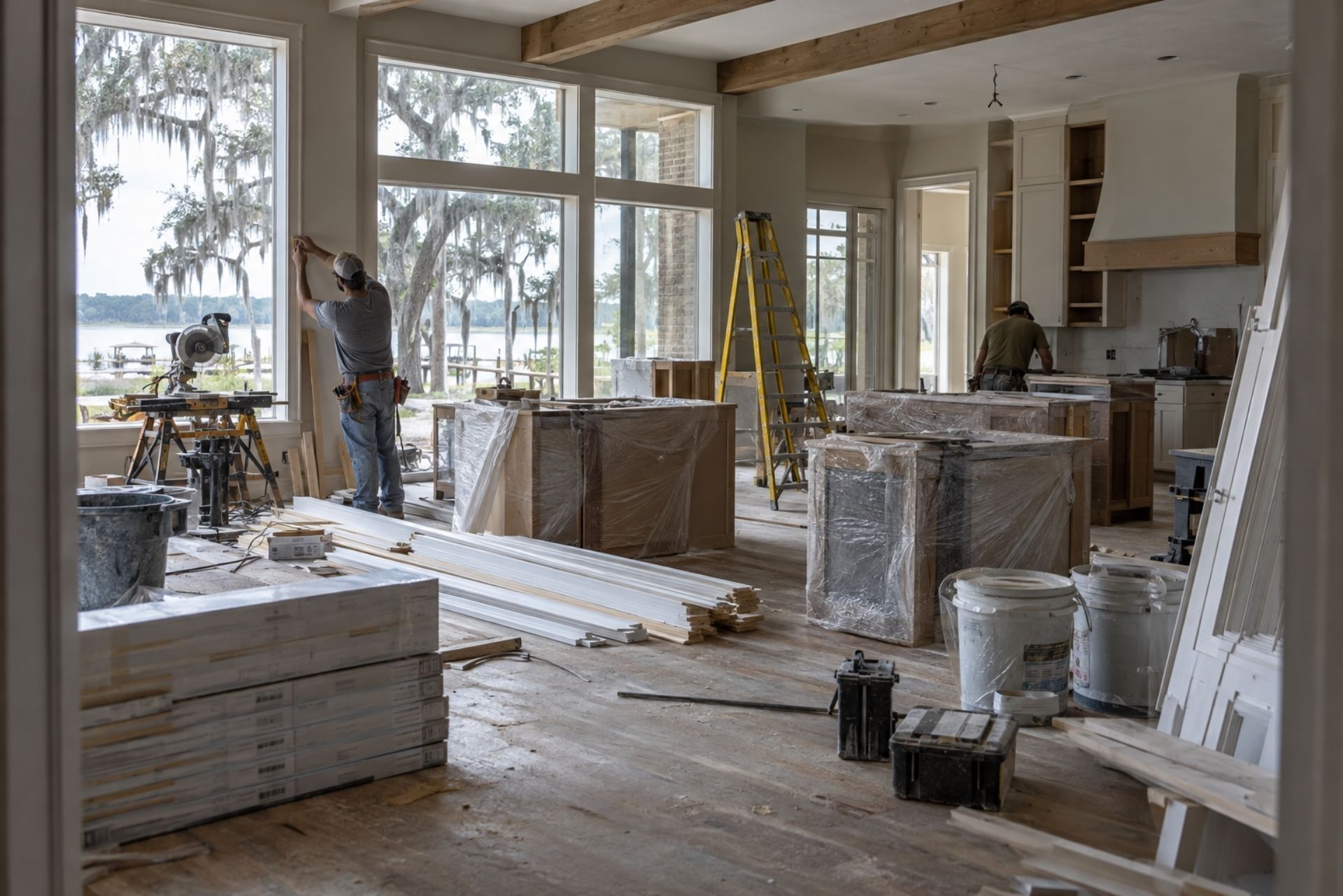
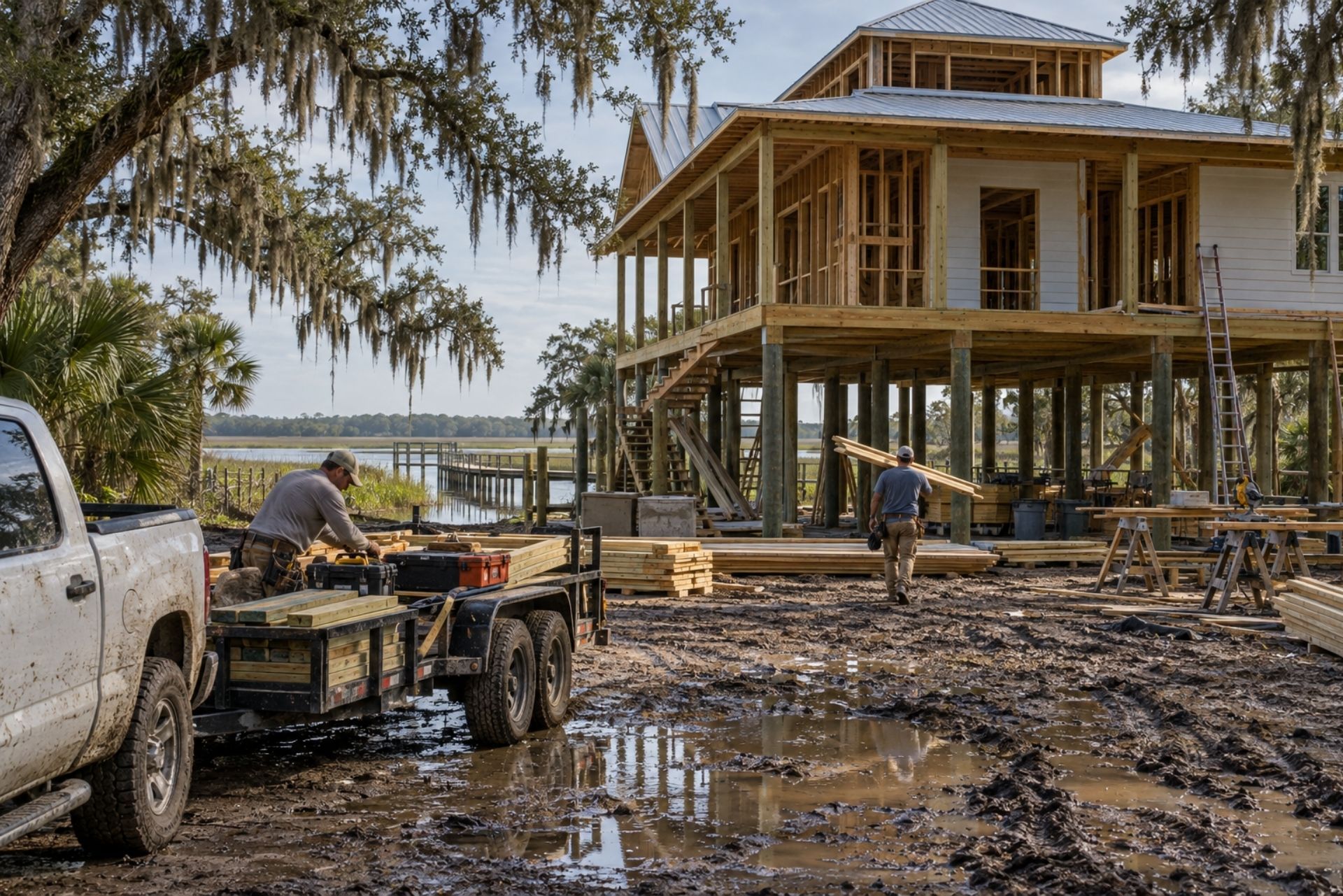
Builders risk insures the structure itself while it's being built: framing, materials on site, and often materials in transit or stored off site. The common mistake we see is a builder who buys a policy for the first house in a subdivision and assumes it carries over to the next three slabs. It may not, unless the policy is written as a reporting form.
Builders who start more than a handful of homes a year typically do well with a reporting or blanket form. You report each new start (usually monthly), and coverage attaches automatically up to a per-location limit. Single-project policies make more sense for a custom builder doing two or three homes annually.
A few points worth checking on any builders risk policy:
- Windstorm and named storm deductibles: In St. Tammany Parish, these are often a percentage of the completed value rather than a flat dollar amount. A 2% deductible on a $450,000 home is $9,000 out of pocket.
- Theft of materials: Copper, appliances, and HVAC units disappear from job sites. Some forms may exclude theft of uninstalled items or require a fenced, locked area.
- Flood: Builders risk generally excludes flood unless it's specifically endorsed. Many lots across the Northshore sit in or near flood zones.
- When coverage ends: Most policies typically terminate at occupancy, sale, or a set number of days after completion. That last trigger matters for spec homes, covered later.
With no lender to satisfy, the decision is yours, and so is the entire loss. A total rebuild in this parish runs well into six figures.
Homeowners who own outright
Your lender requires coverage at least equal to the loan, and will buy a policy on your behalf at your expense if yours lapses.
Homeowners with a mortgage
How Sublimits Affect Overtime and Minimum Wage Disputes
Understanding the LHBA General Liability Trust
The rules changed this year. Under Act 757, Louisiana's minimum general liability requirement for residential contractors rose from $100,000 to $500,000 as of August 1, 2026. Builders who renewed earlier in the year at the old minimum should confirm their limits now, because license compliance depends on it.
The LHBA General Liability Trust is one route many Louisiana builders take. It's a member-owned entity governed by a Board of Trustees made up of active Louisiana builders, which means the people setting policy actually understand residential construction risk. The trust has been in operation since 2003 and provides coverage "at cost" as a non-profit for its members.
It's also a recognized way to satisfy Louisiana's statutory insurance requirements, so builders don't have to wonder whether their certificate will pass muster with the licensing board.
One benefit builders sometimes skip past: members can access model contracts with arbitration language designed to reduce litigation exposure. Construction defect claims are a leading driver of GL losses, and a well-drafted contract can head off disputes before they become lawsuits. Membership in the Louisiana Home Builders Association is required to participate, so factor dues into your cost comparison.

The roof
Age, material and shape drive the wind rate more than any other factor. A fortified roof designation opens markets that would otherwise decline the house.
| Scenario | Dwelling limit | All-other-perils deductible | Named-storm deductible |
|---|---|---|---|
| Newer build, inland St. Tammany | $350,000 | $1,000 | 2% |
| Newer build, higher wind zone | $350,000 | $1,000 | 5% |
| Older home, updated roof | $275,000 | $2,500 | 2% |
| Older home, original roof | $275,000 | $2,500 | 5% |
| Fortified roof designation | $400,000 | $1,000 | 2% |
| Rebuilt after a prior claim | $400,000 | $2,500 | 5% |
| Bundled with auto | $350,000 | $1,000 | 2% |
Exact terms vary by carrier, so treat this as a starting point for comparing quotes.
Workers Comp Through the Homebuilders Self Insurers Fund
Workers comp is where small builders often get surprised, usually at audit time. If you pay subcontractors who can't produce their own certificate of insurance, your carrier may count their payroll as yours and bill you for it retroactively. Collecting current certificates from every sub, every time, is the single habit that prevents the most painful audit bills.
The Homebuilders Self Insurers Fund is a long-running alternative to traditional comp carriers. It operates on a member-owned model where profits go back to policyholders rather than outside shareholders. Since its start in 1979, the fund has returned nearly $70 million in dividends to members.
Dividends aren't guaranteed in any given year, and they depend heavily on the fund's overall loss experience and your own. That's where the safety side comes in. The HSIF offers onsite safety reviews and "Toolbox Talks" that help builders spot hazards before someone falls off a roof or loses a fingertip to a saw.
Fewer claims typically means a better experience modifier, which lowers your premium over time. For a builder running two framing crews, that mod can swing comp costs by thousands of dollars a year. Treat safety meetings as a cost-control tool, not a box to check.
Model Home and Spec Inventory Exposure
Spec homes and model homes sit in an awkward spot. They're no longer under construction, nobody lives in them, and they still belong to you. That combination creates exposure that neither builders risk nor general liability may fully address on its own.
Risks of Completed Unsold Dwellings
Here's a scenario we see too often. A builder finishes a spec home in March, the market softens, and the house is still listed in September. The builders risk policy ended 60 or 90 days after completion. Then a hurricane rolls through, or a pipe bursts in an empty house nobody checked for two weeks.
If the builder didn't move that home onto a vacant dwelling or completed-structure policy, the loss may land entirely on them. Vacancy clauses on many property forms can also reduce or deny coverage for vandalism and water damage once a structure sits empty past a certain period.
The fix is straightforward: track every completion date and line up replacement property coverage before builders risk expires. Your liability policy should also clearly include premises liability for unsold homes, since realtors and prospective buyers walk through them constantly.
Protecting Model Home Contents
Model homes carry furniture, staging décor, electronics, and sometimes a sales office with computers and files. Builders risk typically doesn't cover any of that, and a dwelling policy usually covers only the structure.
Business personal property coverage, written to the model home location, may protect those contents against theft, fire, and wind. Some builders lease staging furniture, which shifts some responsibility, but read the lease: many require the builder to insure the rented items at full value. A model home walk-through with your agent, listing what's inside and who owns it, takes an hour and closes a gap that otherwise shows up only after a break-in.
The roof
Age, material and shape drive the wind rate more than any other factor. A fortified roof designation opens markets that would otherwise decline the house.
| Bond Type | Who Requires It | 2026 Amount | What It Guarantees |
|---|---|---|---|
| Contractor License | LSLBC | $10,000 | Compliance with licensing law |
| Permit Bond | Parish or city | Varies by jurisdiction | Work meets local codes |
| Bid Bond | Public owner | Set by bid documents | You'll sign if awarded |
| Performance Bond | Public owner | Set by contract | Project gets completed |
| Notary (non-attorney) | Secretary of State | $50,000 | Lawful notarial acts |
| Motor Vehicle Dealer | State licensing | Confirm with regulator | Lawful title and sales handling |
Builders generally choose between standard market carriers and LHBA-affiliated programs. Neither is automatically the right fit; it depends on your volume, safety record, and whether you're already an association member.
Comparing Louisiana Builder Coverage Options
Builders generally choose between standard market carriers and LHBA-affiliated programs. Neither is automatically the right fit; it depends on your volume, safety record, and whether you're already an association member.
| Feature | Standard Market Policies | LHBA-Specific Programs |
|---|---|---|
| Ownership | Shareholder or mutual carrier | Member-owned and builder-governed |
| GL limits | Varies by carrier; must meet $500,000 state minimum | Structured to satisfy Louisiana statutory requirements |
| Profit handling | Retained by carrier | GL Trust runs at cost; HSIF may pay dividends |
| Membership required | No | Yes, LHBA membership |
| Louisiana focus | Often multi-state underwriting | Built for Louisiana residential builders |
| Extras | Depends on carrier | Model contracts, safety reviews, Toolbox Talks |
| Flexibility | Can bundle with property, auto, umbrella | Focused on GL and comp specifically |
One thing to keep in mind: association programs handle GL and comp, but you'll still need builders risk, commercial auto, and possibly an umbrella from the standard market. An independent agency can coordinate both sides so the policies don't overlap or leave holes.
Frequently Asked Questions About Builder Insurance
What's the minimum general liability a Louisiana home builder needs in 2026? Residential contractors must carry at least $500,000 in general liability as of August 1, 2026. The previous minimum was $100,000.
Do I need builders risk if I already have general liability? Yes. General liability covers injury and damage to others, while builders risk covers the home you're building. They protect against completely different losses.
Can I join the LHBA General Liability Trust if I'm not an association member? No. Participation typically requires membership in the Louisiana Home Builders Association.
Are HSIF dividends guaranteed? No. Dividends depend on the fund's results and member loss experience, so they may vary from year to year.
What happens to coverage on a spec home after it's finished? Builders risk usually ends at sale, occupancy, or a set period after completion. You'll likely need a vacant or completed dwelling policy to keep it protected while it's listed.
Does workers comp cover my subcontractors? Only if they lack their own coverage, and then your carrier may charge you for their payroll at audit. Always collect current certificates from subs.
The roof
Age, material and shape drive the wind rate more than any other factor. A fortified roof designation opens markets that would otherwise decline the house.
| Bond Type | Who Requires It | 2026 Amount | What It Guarantees |
|---|---|---|---|
| Contractor License | LSLBC | $10,000 | Compliance with licensing law |
| Permit Bond | Parish or city | Varies by jurisdiction | Work meets local codes |
| Bid Bond | Public owner | Set by bid documents | You'll sign if awarded |
| Performance Bond | Public owner | Set by contract | Project gets completed |
| Notary (non-attorney) | Secretary of State | $50,000 | Lawful notarial acts |
| Motor Vehicle Dealer | State licensing | Confirm with regulator | Lawful title and sales handling |
Making the Right Choice for Your Building Business
Protecting a residential construction business in Louisiana comes down to matching coverage to how you actually build. Volume builders usually benefit from a reporting-form builders risk policy, while custom builders may prefer project-specific coverage. The new $500,000 GL minimum makes it worth reviewing your limits now rather than at renewal, and the LHBA trust and HSIF give association members a builder-governed alternative with real perks like model contracts and safety support.
Don't let spec inventory and model homes slip through the cracks. Those are the claims that blindside builders, because everyone assumed some other policy picked them up.
Aubert Insurance Agency has served Covington, Slidell, and St. Tammany Parish since 1910, and we take the time to explain what each policy covers and excludes. Start a Quote today, and we'll compare association programs and standard carriers side by side so every Louisiana start you put in the ground is properly protected.

About the Author
Kyle Beerbohm
President
We've been independent since 1910, and four generations of local ownership have kept us that way. We're one of the oldest agencies in St. Tammany Parish and the fourth oldest business in the City of Covington. I treat that history as a responsibility rather than a plaque on the wall. My job is to keep us answering to the families and business owners who walk through our doors, and to keep serving this parish for another hundred years.
Louisiana Insurance Questions, Answered
Questions clients ask us
Short, plain answers to what people ask before they call. Anything else, phone the office and ask.
What does an independent insurance agency do?
We represent you, not one insurance company. We gather your information once, then compare coverage and price across the carriers we hold contracts with. You get choices, and one agent handles the paperwork.
Which types of insurance does Aubert offer?
We write 13 personal lines, including home, auto, flood, boat, and life. We write 15 commercial lines, including business owners policies, general liability, workers compensation, and commercial property.
Do I need flood insurance in St. Tammany Parish?
Your homeowners policy excludes flood, and much of the Northshore has flooded outside mapped high-risk zones. Lenders require it inside those zones. We check your flood zone and quote NFIP and private options.
Which states are you licensed in?
We hold licenses in Louisiana, Mississippi, Florida, and Texas. License numbers appear in the footer of every page on this site.
How do you find me a competitive rate?
We take your details once and market them to the carriers and wholesale brokers that fit your risk. We compare the offers, explain the differences in coverage, and recommend the strongest fit.
How do I file a claim or request a certificate?
Call the office or use the Client Center on this site. We report the claim, follow the adjuster, and send certificates of insurance to whoever needs them.

Personal Insurance in Louisiana
Coverage for your home, your vehicles, and your family
Thirteen personal lines sit under one roof. Start with the coverage you need most, and we price it across our markets.
Home Insurance
Protect your house, its contents, and your liability with a policy priced across many Louisiana homeowners carriers.
Car Insurance
Cover every driver and vehicle in your household, and compare limits and deductibles side by side before you buy.
Flood Insurance
Standard home policies exclude flood. We write NFIP and private flood coverage for St. Tammany Parish properties.
Umbrella Insurance
Add a layer of liability above your home and auto limits, so one serious claim never reaches your savings.
Boat Insurance
Cover your hull, motor, trailer, and liability on the lake, the river, and the Gulf, wherever you launch.
Life Insurance
Replace your income for the people who depend on it, with term and permanent options we quote across carriers.
Business Insurance in Louisiana
Coverage for the business you built
Fifteen commercial lines, written for the payrolls, fleets, and buildings that Louisiana carriers ask hard questions about.
Contractors Insurance
General contractors, trade contractors and specialty crews. We cover the liability, tools, vehicles and workers your jobs depend on.
Business Owners (BOP)
One policy bundling property and liability for a small business. Straightforward cover for the building, the contents and the risk.
Professional Liability
Protection when your advice or professional work is challenged. A staple of any commercial package for a service business.
Commercial Property
Landlords and commercial real estate investors. We insure the building, the habitation risk and the income it produces.
Workers Compensation
Protecting your employees protects your business. Medical costs and lost wages covered when someone is hurt on the job.
Commercial Auto
Trucks, vans and fleets. We shop a wide range of commercial auto markets to match your vehicles and your drivers.
Business Insurance by Industry
We protect hundreds of businesses of all shapes and sizes
We know the exposures, the contract language, and the markets that write these trades on the Northshore.

General Contractors
Builders risk, general liability, and comp for homebuilders and remodelers working across St. Tammany Parish.

Plumber Insurance
Plumbers, electricians, roofers, and painters get liability, tools, and auto coverage that satisfies job requirements.

Restaurants
Property, liquor liability, spoilage, and comp for kitchens, bars, and cafés, including Louisiana association programs.
5-Star Rated by St. Tammany Clients
What Our Clients Say
Neighbours, business owners, and families across Covington and Slidell tell the story better than we can.


Insurance Tips & Local News
Insurance tips for Louisiana homes and businesses
Practical reading on flood zones, hurricane deductibles, and the coverage questions local business owners raise.
Request Your Free Insurance Quote
Tell us what you need covered
Send the form or call the office. A licensed agent in Covington or Slidell answers you directly.
614 E. Boston St., Covington, LA 70433. (985) 892-3101
58418 Tyler Drive, Slidell, LA 70461 · (985) 641-0520
Call
614 E. Boston St., Covington, LA 70433
58418 Tyler Drive, Slidell, LA 70461













