

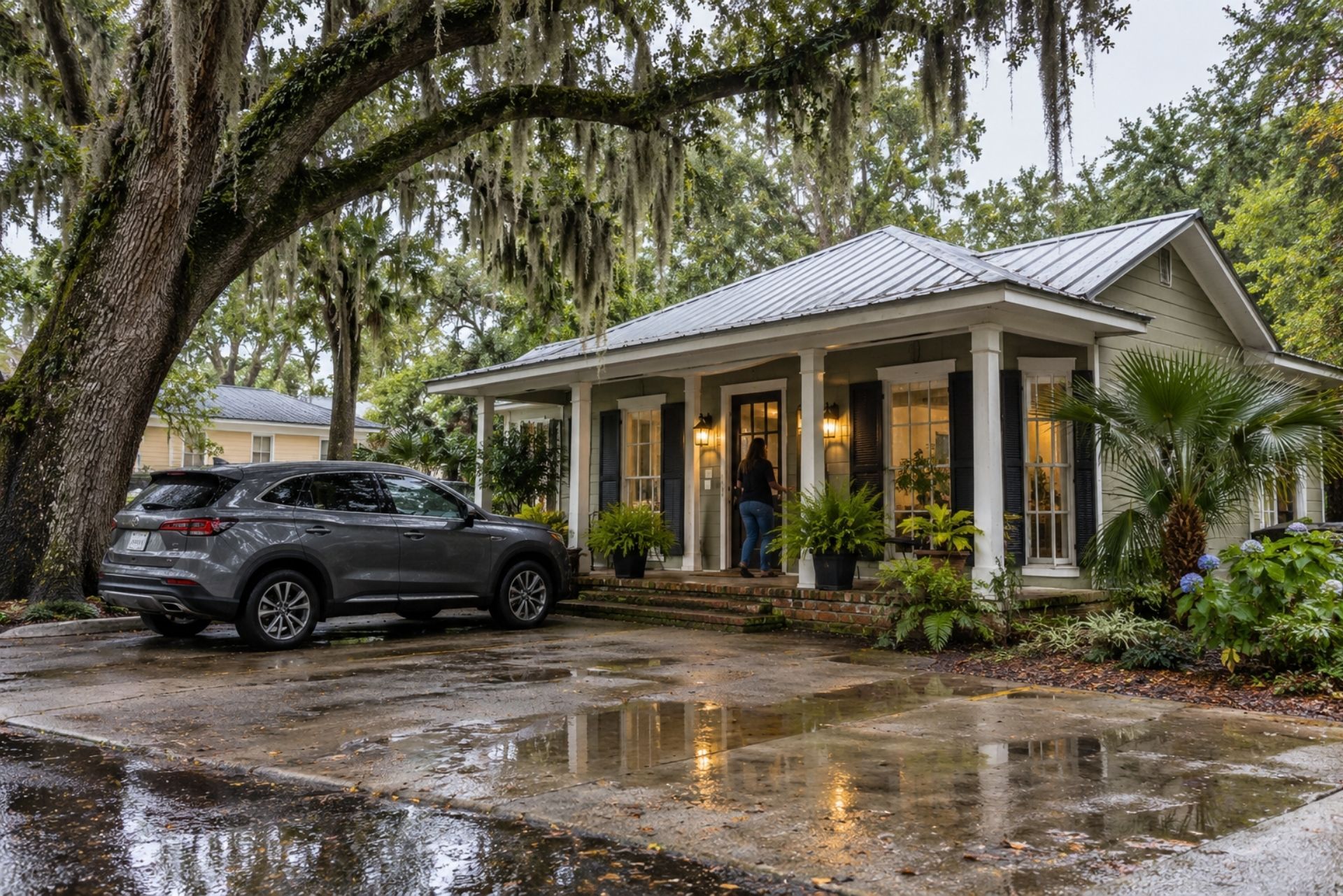












Covington & Slidell Independent Insurance Agents
Wright Flood is the largest private company servicing National Flood Insurance Program policies, and Louisiana homeowners usually reach it through a local independent agent. That agent writes the federal policy, helps gather elevation data, supports you through claims after a storm, and can compare NFIP coverage against private flood options when it makes sense.
If you live in St. Tammany Parish, you already know the routine. A named storm shows up in the Gulf, the bread aisle empties, and someone in your neighborhood asks whether their homeowners policy covers flooding. It doesn't. Flood is a separate contract, and for most people in Covington, Slidell, Mandeville, and Lacombe, that contract carries the Wright Flood name.
This guide covers what Louisiana flood buyers ask most: how Wright-serviced NFIP policies actually work, what happens when you file a claim after the water goes down, why an elevation certificate can change your premium, and when a private flood quote deserves a look.
Timing matters this year. Congress has extended the NFIP through December 11, 2026, and the program now runs fully under FEMA's Risk Rating 2.0 pricing. If you're buying a house, renewing a policy, or still paying a premium that jumped after the rating change, the next few months are a good window to review your coverage before the next hurricane season or a possible lapse.
Understanding Wright Flood Insurance Policies in Louisiana
Wright Flood is the nation's largest "Write Your Own" carrier for the NFIP. It issues and services federal flood policies under its own name, while FEMA sets the rates and coverage rules. Local Louisiana agents quote, bind, and maintain these contracts for homeowners and businesses.
Here's the part that confuses people: Wright doesn't invent its own flood policy when it writes NFIP coverage. It acts as the administrator. The nation's largest WYO provider for the NFIP handles billing, policy documents, and claims, but the coverage forms, limits, and premiums come from the federal program. A Wright NFIP policy in Slidell reads the same as an NFIP policy written by another WYO company.
That scale matters in Louisiana. As of April 2026, the state held roughly 406,717 NFIP policies, about 9% of the national total. Few states rely on this program the way we do.
Your local agent is the person who knows your street, your flood zone, and whether your lender requires coverage. At Aubert Insurance Agency, we've been insuring St. Tammany families since 1910, and a big part of that work is explaining what the flood contract actually says before you need it.

On this page
Aubert Insurance Agency is a local, independent agency, licensed to serve individuals and businesses across Louisiana, Mississippi, Florida and Texas.
We serve clients from our offices in Covington and Slidell and throughout St. Tammany Parish — working with dozens of carriers and wholesale markets to help homeowners, drivers, contractors, restaurant owners, property investors, auto shops, professional practices and many other personal and commercial clients find coverage that fits.
Licensed in Louisiana #3661 · Mississippi #15039075 · Florida #W0772236 · Texas #2381820
How NFIP Flood Policies Serviced by Wright Work
An NFIP policy has two separate coverage buckets, and you choose a limit for each:
- Building coverage: up to $250,000 for a residential structure. This covers the foundation, electrical and plumbing systems, HVAC, water heaters, built-in appliances, and permanently installed flooring and cabinets.
- Contents coverage: up to $100,000 for personal belongings like furniture, clothing, and electronics. It's optional, and many people skip it without realizing it.
A few policy details catch people off guard. New NFIP policies typically carry a 30-day waiting period before coverage starts, unless the purchase is tied to a home closing or loan. Basements and areas below the lowest elevated floor have limited coverage, so finished space under a raised Slidell home may not be fully covered. Contents are usually paid at actual cash value, meaning depreciation comes off the check.
Pricing now follows FEMA's Risk Rating 2.0, which looks at your specific property rather than only your flood zone. Distance to water, flood frequency, rebuilding cost, and the elevation of your first floor all affect the rate. The full implementation of Risk Rating 2.0 is why two neighbors in the same zone can now pay very different premiums.
With no lender to satisfy, the decision is yours, and so is the entire loss. A total rebuild in this parish runs well into six figures.
Homeowners who own outright
Your lender requires coverage at least equal to the loan, and will buy a policy on your behalf at your expense if yours lapses.
Homeowners with a mortgage
Accounting firms hold Social Security numbers, bank details, and tax records, which makes them prime targets. One industry observer put it bluntly: for most CPA firms, cyber insurance is no longer optional, and failing to meet MFA and EDR requirements can result in denied claims or total exclusion from the market. Translation: carriers now want multi-factor authentication and endpoint detection software in place before they will write you, and they may check after a claim. A cyber policy may cover breach notification, forensic investigation, ransomware response, and lawsuits from affected clients.
Cyber Liability
How Claims Are Handled After a Storm
The claims process after a major Louisiana storm follows a fairly set sequence. Knowing it ahead of time helps you avoid the mistakes that slow down payment.
- Report the loss quickly. Call your agent or Wright Flood's claims line as soon as it's safe. After a big event, thousands of St. Tammany claims may come in within days, and early reporting typically gets you into the adjuster queue sooner.
- Document everything before cleanup. Take photos and video of water lines on the walls, damaged flooring, and ruined belongings. Don't throw out carpet or drywall until you've photographed it, and save a small sample of flooring if you can.
- Prevent further damage. Pull out wet materials and start drying the house. Reasonable mitigation is expected, and mold that grows because a home sat wet for weeks may create coverage disputes.
- Meet the adjuster. Wright assigns an independent flood adjuster who inspects the property, measures the water depth, and writes up an estimate. Walk the house with them and point out everything, including damage to ductwork and the water heater.
- Sign the Proof of Loss. NFIP claims generally require a signed Proof of Loss, typically within 60 days of the flood. Your adjuster often prepares it, but you're responsible for reviewing and submitting it.
One common problem we see: people assume the adjuster works for them. The adjuster works the claim, but you're the one who has to prove the loss. Keep receipts, a home inventory, and your policy declarations in a cloud folder before storm season. If you disagree with the settlement, the NFIP has an appeal process, and your agent can help you understand your options.

The roof
Age, material and shape drive the wind rate more than any other factor. A fortified roof designation opens markets that would otherwise decline the house.
The Role of Elevation Certificates in Your Premium
An elevation certificate is a form completed by a licensed surveyor that records how high your home sits compared to the expected flood level in your area. It measures the lowest floor, the adjacent grade, and the location of equipment like AC units.
Under Risk Rating 2.0, the certificate is no longer mandatory for every rating, but it can still help. FEMA uses internal models to estimate your first-floor height. If your home actually sits higher than those models assume, providing an Elevation Certificate can lead to lower premiums.
That's common in older Covington neighborhoods and raised homes around Slidell, where houses were built up on piers or fill. A survey may cost a few hundred dollars, but on a property where the model underestimates elevation, the savings can repeat every year.
Before ordering one, check whether a certificate already exists. Ask the seller, your parish permit office, or your agent, since many homes built or renovated after flood-zone mapping already have one on file. A certificate can also hurt you if the home sits lower than the model assumed, so it's worth a conversation with your agent before submitting it.
How Jones Act Exposure Differs From State Workers Comp
When Private Flood Is Worth Comparing
The NFIP caps building coverage at $250,000 and contents at $100,000. For a newer home in Covington or a waterfront property near Lake Pontchartrain, rebuilding costs may easily run past that limit. That gap is the main reason private flood quotes deserve a look.
Private flood carriers set their own underwriting. Some may offer higher building limits, replacement cost on contents, additional living expenses while you're displaced, or shorter waiting periods. Some price risk differently than FEMA, which can mean a lower premium on certain homes and a higher one on others. Louisiana's private market has grown alongside Risk Rating 2.0, and Wright Flood itself offers private products in addition to its NFIP business.
Program stability is another reason to compare. Local agents warn that a lapse after December 11, 2026, would halt new policy issuances and renewals, though existing claims would still be paid. If you're closing on a house near that date, a private option may keep the deal on track.
The catch: private policies vary widely, and some may be cancelled with notice in ways an NFIP policy cannot. Read exclusions carefully, and confirm your lender will accept the policy.
NFIP vs. Private Flood Insurance Comparison
| Feature | NFIP (via Wright) | Private Flood |
|---|---|---|
| Building limit | Up to $250,000 | May go higher, varies by carrier |
| Contents limit | Up to $100,000 | May go higher |
| Contents payout | Actual cash value | Replacement cost may be available |
| Living expenses | Not included | Often available |
| Waiting period | Typically 30 days | May be shorter |
| Pricing | FEMA Risk Rating 2.0 | Carrier underwriting |
| Affected by NFIP lapse | Yes, new and renewals | No |
The roof
Age, material and shape drive the wind rate more than any other factor. A fortified roof designation opens markets that would otherwise decline the house.
| Feature | General Liability | Professional Liability (E&O) |
|---|---|---|
| What it covers | Physical injuries and property damage | Mistakes, oversights, bad advice |
| Example claim | Client slips in your lobby | Missed tax deadline costs a client penalties |
| Included in a BOP? | Usually yes | Usually no |
| Who needs it | Nearly every office with visitors | Accountants, consultants, agencies giving advice |
| Policy trigger | Usually occurrence-based | Usually claims-made |
Common Questions About Louisiana Flood Coverage
Does my homeowners policy cover flood damage from a hurricane? No. Wind damage is typically covered by homeowners or wind policies, but rising water requires a separate flood policy.
Do I need flood insurance if I'm not in a high-risk zone? Your lender may not require it, but many Louisiana flood claims come from moderate and low-risk areas. Coverage outside high-risk zones is often priced lower.
Can I switch from NFIP to private flood and back? Usually, yes. Just ask your agent how a gap in NFIP coverage could affect any rating benefits before you switch.
How long does a flood claim take to pay? It depends on the size of the storm and how quickly you submit documentation. Smaller events may settle within weeks, while major hurricanes can take longer.
Will my premium go up every year under Risk Rating 2.0? Some policies are still transitioning toward their full-risk rate, so annual increases may continue for a while. An elevation certificate or mitigation like venting may help.
What happens to my policy if the NFIP lapses? Existing policies stay in force until expiration and claims still get paid, but renewals and new policies would pause until Congress acts.
How Jones Act Exposure Differs From State Workers Comp
Making the Right Choice for Your Property
Flood coverage in St. Tammany isn't a box you check at closing and forget. A Wright NFIP policy gives you a federally backed foundation, an elevation certificate may bring that price down, and a private quote can fill gaps the NFIP leaves, especially on higher-value homes or during an uncertain reauthorization period.
The right answer depends on your flood zone, your home's elevation, and how much it would actually cost to rebuild. An independent agency can put Wright NFIP pricing next to private flood options so you see the differences in limits, payouts, and exclusions side by side, rather than guessing.
If you live in Covington, Slidell, or anywhere in St. Tammany Parish, reach out to Aubert Insurance Agency. We'll review your flood zone, check for an existing elevation certificate, walk you through what your policy does and doesn't cover, and shop the options for you. Start a Quote today, well before the next storm forms in the Gulf.

About the Author
Kyle Beerbohm
President
We've been independent since 1910, and four generations of local ownership have kept us that way. We're one of the oldest agencies in St. Tammany Parish and the fourth oldest business in the City of Covington. I treat that history as a responsibility rather than a plaque on the wall. My job is to keep us answering to the families and business owners who walk through our doors, and to keep serving this parish for another hundred years.
Louisiana Insurance Questions, Answered
Questions clients ask us
Short, plain answers to what people ask before they call. Anything else, phone the office and ask.
What does an independent insurance agency do?
We represent you, not one insurance company. We gather your information once, then compare coverage and price across the carriers we hold contracts with. You get choices, and one agent handles the paperwork.
Which types of insurance does Aubert offer?
We write 13 personal lines, including home, auto, flood, boat, and life. We write 15 commercial lines, including business owners policies, general liability, workers compensation, and commercial property.
Do I need flood insurance in St. Tammany Parish?
Your homeowners policy excludes flood, and much of the Northshore has flooded outside mapped high-risk zones. Lenders require it inside those zones. We check your flood zone and quote NFIP and private options.
Which states are you licensed in?
We hold licenses in Louisiana, Mississippi, Florida, and Texas. License numbers appear in the footer of every page on this site.
How do you find me a competitive rate?
We take your details once and market them to the carriers and wholesale brokers that fit your risk. We compare the offers, explain the differences in coverage, and recommend the strongest fit.
How do I file a claim or request a certificate?
Call the office or use the Client Center on this site. We report the claim, follow the adjuster, and send certificates of insurance to whoever needs them.

Personal Insurance in Louisiana
Coverage for your home, your vehicles, and your family
Thirteen personal lines sit under one roof. Start with the coverage you need most, and we price it across our markets.
Home Insurance
Protect your house, its contents, and your liability with a policy priced across many Louisiana homeowners carriers.
Car Insurance
Cover every driver and vehicle in your household, and compare limits and deductibles side by side before you buy.
Flood Insurance
Standard home policies exclude flood. We write NFIP and private flood coverage for St. Tammany Parish properties.
Umbrella Insurance
Add a layer of liability above your home and auto limits, so one serious claim never reaches your savings.
Boat Insurance
Cover your hull, motor, trailer, and liability on the lake, the river, and the Gulf, wherever you launch.
Life Insurance
Replace your income for the people who depend on it, with term and permanent options we quote across carriers.
Business Insurance in Louisiana
Coverage for the business you built
Fifteen commercial lines, written for the payrolls, fleets, and buildings that Louisiana carriers ask hard questions about.
Contractors Insurance
General contractors, trade contractors and specialty crews. We cover the liability, tools, vehicles and workers your jobs depend on.
Business Owners (BOP)
One policy bundling property and liability for a small business. Straightforward cover for the building, the contents and the risk.
Professional Liability
Protection when your advice or professional work is challenged. A staple of any commercial package for a service business.
Commercial Property
Landlords and commercial real estate investors. We insure the building, the habitation risk and the income it produces.
Workers Compensation
Protecting your employees protects your business. Medical costs and lost wages covered when someone is hurt on the job.
Commercial Auto
Trucks, vans and fleets. We shop a wide range of commercial auto markets to match your vehicles and your drivers.
Business Insurance by Industry
We protect hundreds of businesses of all shapes and sizes
We know the exposures, the contract language, and the markets that write these trades on the Northshore.

General Contractors
Builders risk, general liability, and comp for homebuilders and remodelers working across St. Tammany Parish.

Plumber Insurance
Plumbers, electricians, roofers, and painters get liability, tools, and auto coverage that satisfies job requirements.

Restaurants
Property, liquor liability, spoilage, and comp for kitchens, bars, and cafés, including Louisiana association programs.
5-Star Rated by St. Tammany Clients
What Our Clients Say
Neighbours, business owners, and families across Covington and Slidell tell the story better than we can.


Insurance Tips & Local News
Insurance tips for Louisiana homes and businesses
Practical reading on flood zones, hurricane deductibles, and the coverage questions local business owners raise.
Request Your Free Insurance Quote
Tell us what you need covered
Send the form or call the office. A licensed agent in Covington or Slidell answers you directly.
614 E. Boston St., Covington, LA 70433. (985) 892-3101
58418 Tyler Drive, Slidell, LA 70461 · (985) 641-0520
Visit
614 E. Boston St., Covington, LA 70433
58418 Tyler Drive, Slidell, LA 70461













