













Covington & Slidell Independent Insurance Agents
Louisiana drywall contractors face a specific set of claims: falls from stilts and scaffolds, mold blamed on wet board, injured labor-only subs, and dust complaints from homeowners who never left the house. The right insurance package addresses each of these while keeping your state license active under the 2026 rule changes.
Most drywall claims don't start with a disaster. They start with a homeowner noticing a gray film on the piano, or a sub's helper stepping off a plank wrong on a Tuesday afternoon in Mandeville. This guide covers where coverage tends to break down for drywallers in St. Tammany Parish and across Louisiana, and what to check before your next renewal.
Louisiana Drywall Contractor Insurance Overview
Drywall insurance in Louisiana protects your business against the trade's most common risks: worker falls, mold allegations, damage to a client's property, and dust complaints. It also keeps you compliant with state licensing rules, which now require residential contractors to carry specific minimum limits and maintain continuous coverage.
The licensing piece changed significantly this year. Residential contractors, including drywall and mold remediation specialists, must carry at least $500,000 in general liability insurance as of August 1, 2026. The board also gained expanded authority to immediately suspend or revoke a license when coverage lapses or no longer matches your licensed scope.
Paperwork matters more now too. Certificates of insurance must name the LSLBC as certificate holder and cannot exclude your licensed work. That last point catches people. A policy with a broad mold or EIFS exclusion that touches your actual scope may create a licensing problem as well as a claims problem.
On cost, solo drywall operators in Louisiana typically pay between $700 and $1,300 a year for general liability, depending on payroll, claims history, and the type of work.

On this page
Aubert Insurance Agency is a local, independent agency, licensed to serve individuals and businesses across Louisiana, Mississippi, Florida and Texas.
We serve clients from our offices in Covington and Slidell and throughout St. Tammany Parish — working with dozens of carriers and wholesale markets to help homeowners, drivers, contractors, restaurant owners, property investors, auto shops, professional practices and many other personal and commercial clients find coverage that fits.
Licensed in Louisiana #3661 · Mississippi #15039075 · Florida #W0772236 · Texas #2381820
Managing Risks of Stilts and Scaffold Injuries
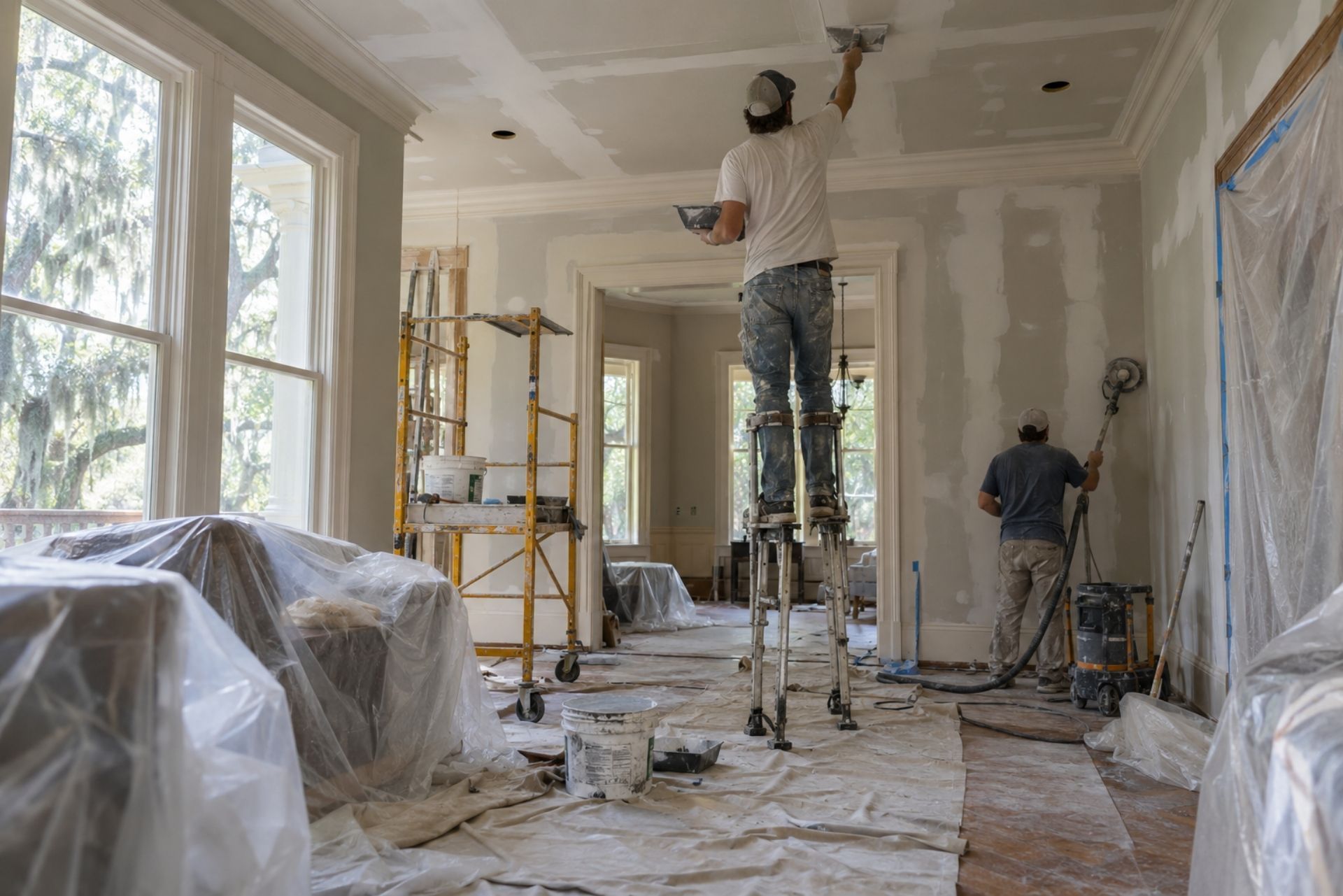
Stilts are efficient and they're also one of the fastest ways to end up with a workers' comp claim. A taper on 24-inch stilts who catches a cord or a scrap of corner bead falls from a height that easily causes wrist fractures, knee injuries, and head trauma. Baker scaffolds and rolling platforms add their own risks: unlocked casters, missing guardrails, and planks laid across buckets when someone's in a hurry.
Workers' compensation pays medical bills and lost wages for your employees, regardless of fault. General liability does not cover your own workers. Where people get burned is when a homeowner, another trade, or a visiting family member trips over your scaffold. That third-party injury falls under general liability, and some carriers may add exclusions or higher rates for scaffold work above certain heights, so read the classification carefully.
A few habits that help with both safety and claims defense:
- Floor clearing before stilt work: Document it with a quick photo each morning.
- Locked casters and guardrails: Make them non-negotiable on rolling scaffolds.
- Written stilt policy: Specify who is trained and allowed to use them.
- Incident reporting within 24 hours: Late reports are a common reason claims get contested.
With no lender to satisfy, the decision is yours, and so is the entire loss. A total rebuild in this parish runs well into six figures.
Homeowners who own outright
Your lender requires coverage at least equal to the loan, and will buy a policy on your behalf at your expense if yours lapses.
Homeowners with a mortgage
Water-Damaged Board and Mold Allegations
In south Louisiana humidity, mold claims against drywallers are a when, not an if. The typical scenario: a roof leak or plumbing issue soaks a wall months after you finished, mold appears, and the homeowner's attorney names everyone who touched the wall. Your crew hung board that later got wet, so you get pulled in.
The harder cases involve board you installed while it was already compromised. Hanging sheets that sat in a rain-soaked garage, or closing up walls over damp framing before the house was dried in, can give an adjuster a reason to look closely at your work. Keep moisture meter readings and photos of framing before you hang, especially on post-storm rebuilds.
Coverage-wise, many general liability policies contain mold or fungi exclusions. Some carriers may offer limited mold buy-back coverage, typically with a sublimit well below your main policy limit. Given the LSLBC's position that your certificate cannot exclude licensed work, ask your agent directly whether your policy's mold language creates any conflict with your license classification. This conversation is worth having before a claim, not after.

The roof
Age, material and shape drive the wind rate more than any other factor. A fortified roof designation opens markets that would otherwise decline the house.
Protecting Against Dust Claims in Occupied Homes
Remodels in occupied homes generate a distinct type of complaint. Sanding joint compound releases fine dust that drifts through HVAC returns, settles on electronics, and works into upholstery. Homeowners file claims for professional cleaning, ruined furniture, replaced air handlers, and sometimes respiratory complaints for children or elderly residents.
Many of these disputes come down to proof. Contractors without pre-work photo documentation of existing finishes are about 70% more likely to lose nuisance dust disputes in occupied residential settings. If you can't show the TV already had a scratch or the rug was already stained, you're likely paying for it.
Practical steps that tend to reduce both claims and arguments:
- Photograph every room adjacent to the work area before starting, including furniture and floors.
- Seal HVAC returns and use zip walls or plastic barriers.
- Use dust-control sanders with vacuum attachments where practical.
- Put cleanup expectations in your written contract.
General liability may cover property damage from dust, but small claims often fall under your deductible. Good documentation is cheaper than either.
Covington & Slidell Independent Insurance Agents
The Complexity of Labor-Only Subcontractors
Plenty of Louisiana drywall outfits run lean: an owner, a pickup, and a rotating group of hangers and finishers paid by the board or by the job. That model is legal, but the paperwork has tightened. Subcontractors in the Furnishing Labor Only classification must provide proof of both workers' compensation and liability insurance to the licensing board.
The bigger shift: under House Bill 185, labor-only subs who spend a substantial portion of their time doing manual labor are legally viewed as employees for workers' comp purposes as of August 1, 2026. If your sub's guy falls off a scaffold and the sub has no valid coverage, the claim may land on your policy. At audit, your carrier may also charge premium on payroll paid to uninsured subs.
Collect a current certificate from every sub before they start, set calendar reminders for expiration dates, and keep copies in one file.
Workers Compensation vs General Liability
These two policies get confused constantly. Workers' compensation covers injuries to people working for you, including uninsured subs who may be treated as your employees. General liability covers injuries to other people and damage to their property, like a homeowner who trips over a mud pan or a hardwood floor gouged by a scaffold leg. You typically need both, and one doesn't fill the other's gaps.
not, unless you're both named on the policy. Each roommate typically needs their own coverage, and shared policies can get messy when one person files a claim.
Will my renters insurance cover my dog biting someone? Many policies include pet liability under personal liability, but some carriers exclude certain breeds or cap dog bite claims. Tell your agent about your pet upfront so there's no surprise later.
Does my landlord's insurance cover my belongings? No. Your landlord's policy typically covers the building only, so your furniture, clothes and electronics need your own policy.
When should I buy flood insurance before hurricane season? Aim for spring. NFIP contents coverage generally has a 30-day waiting period, so buying in late May means protection by the heart of the season.
What should I do to prepare my rental for a hurricane? Take a video walkthrough of every room, save receipts for big items in the cloud and keep a copy of your policy on your phone. Good documentation is the single biggest factor in how fast a storm claim gets paid.
Will renters insurance pay for a hotel if we evacuate? It depends. Loss of use typically kicks in when your rental is uninhabitable from a covered loss or when a civil authority orders evacuation, but check your policy wording.
The roof
Age, material and shape drive the wind rate more than any other factor. A fortified roof designation opens markets that would otherwise decline the house.
Comparing Coverage Needs for Louisiana Drywallers
Here's how the main policies stack up for a typical drywall operation in St. Tammany Parish.
| Coverage | What It Covers | Example Claim | Required for License? |
|---|---|---|---|
| General Liability | Injury to others, damage to client property | Dust ruins a homeowner's sofa | Yes, $500,000 minimum (residential) |
| Workers' Compensation | Your employees' injuries and lost wages | Taper falls from stilts | Required if you have employees; proof needed for labor-only subs |
| Professional Liability | Errors in advice or design | Rarely relevant unless you design or consult | No |
| Mold Buy-Back | Limited mold claims, if offered | Mold blamed on board you installed | No, but often worth considering |
For most drywallers, professional liability is the least pressing of these. The real value sits in a properly classified GL policy and workers' comp that actually reflects your crew setup.
Common Questions About Drywall Insurance
Do I need insurance if I work alone? Yes. Louisiana residential contractors must carry general liability to hold a license, and the minimum is now $500,000. Workers' comp rules depend on whether you have employees or use subs.
Does general liability cover mold? Often not fully. Many policies exclude mold, though some carriers may offer limited coverage through an add-on.
What happens if my insurance lapses? The licensing board can suspend or revoke your license immediately. Even a short gap can stop you from working.
Are my subcontractors covered under my policy? Not automatically. If they don't have their own valid workers' comp, their injured workers may become your claim.
Can I lower my premium? Possibly. Louisiana's insurance commissioner has said that "policyholders must shop around to take advantage of these rate decreases."
What should my certificate of insurance show? It must name the LSLBC as certificate holder and cannot include exclusions for your licensed work.
The roof
Age, material and shape drive the wind rate more than any other factor. A fortified roof designation opens markets that would otherwise decline the house.
Your Next Steps for Local Coverage
The 2026 changes raised the stakes for drywall contractors. Higher GL minimums, stricter certificate rules, and new treatment of labor-only subs mean an old policy may no longer match your work or your license. The board put it plainly: "Your insurance policy needs to match the work you actually perform."
Start with a review. Pull your current policy and check the mold language, your class codes, your scaffold or height restrictions, and the certificates you have on file for every sub. Note anything that looks like it might exclude part of your licensed scope.
Aubert Insurance Agency has served contractors in Covington and Slidell since 1910. As an independent agency, we compare options from multiple carriers and explain what each policy covers and excludes, so you understand the contract before you sign. If your coverage needs a second look before your next job, we can help.

About the Author
Kyle Beerbohm
President
We've been independent since 1910, and four generations of local ownership have kept us that way. We're one of the oldest agencies in St. Tammany Parish and the fourth oldest business in the City of Covington. I treat that history as a responsibility rather than a plaque on the wall. My job is to keep us answering to the families and business owners who walk through our doors, and to keep serving this parish for another hundred years.
Louisiana Insurance Questions, Answered
Questions clients ask us
Short, plain answers to what people ask before they call. Anything else, phone the office and ask.
What does an independent insurance agency do?
We represent you, not one insurance company. We gather your information once, then compare coverage and price across the carriers we hold contracts with. You get choices, and one agent handles the paperwork.
Which types of insurance does Aubert offer?
We write 13 personal lines, including home, auto, flood, boat, and life. We write 15 commercial lines, including business owners policies, general liability, workers compensation, and commercial property.
Do I need flood insurance in St. Tammany Parish?
Your homeowners policy excludes flood, and much of the Northshore has flooded outside mapped high-risk zones. Lenders require it inside those zones. We check your flood zone and quote NFIP and private options.
Which states are you licensed in?
We hold licenses in Louisiana, Mississippi, Florida, and Texas. License numbers appear in the footer of every page on this site.
How do you find me a competitive rate?
We take your details once and market them to the carriers and wholesale brokers that fit your risk. We compare the offers, explain the differences in coverage, and recommend the strongest fit.
How do I file a claim or request a certificate?
Call the office or use the Client Center on this site. We report the claim, follow the adjuster, and send certificates of insurance to whoever needs them.

Personal Insurance in Louisiana
Coverage for your home, your vehicles, and your family
Thirteen personal lines sit under one roof. Start with the coverage you need most, and we price it across our markets.
Home Insurance
Protect your house, its contents, and your liability with a policy priced across many Louisiana homeowners carriers.
Car Insurance
Cover every driver and vehicle in your household, and compare limits and deductibles side by side before you buy.
Flood Insurance
Standard home policies exclude flood. We write NFIP and private flood coverage for St. Tammany Parish properties.
Umbrella Insurance
Add a layer of liability above your home and auto limits, so one serious claim never reaches your savings.
Boat Insurance
Cover your hull, motor, trailer, and liability on the lake, the river, and the Gulf, wherever you launch.
Life Insurance
Replace your income for the people who depend on it, with term and permanent options we quote across carriers.
Business Insurance in Louisiana
Coverage for the business you built
Fifteen commercial lines, written for the payrolls, fleets, and buildings that Louisiana carriers ask hard questions about.
Contractors Insurance
General contractors, trade contractors and specialty crews. We cover the liability, tools, vehicles and workers your jobs depend on.
Business Owners (BOP)
One policy bundling property and liability for a small business. Straightforward cover for the building, the contents and the risk.
Professional Liability
Protection when your advice or professional work is challenged. A staple of any commercial package for a service business.
Commercial Property
Landlords and commercial real estate investors. We insure the building, the habitation risk and the income it produces.
Workers Compensation
Protecting your employees protects your business. Medical costs and lost wages covered when someone is hurt on the job.
Commercial Auto
Trucks, vans and fleets. We shop a wide range of commercial auto markets to match your vehicles and your drivers.
Business Insurance by Industry
We protect hundreds of businesses of all shapes and sizes
We know the exposures, the contract language, and the markets that write these trades on the Northshore.

General Contractors
Builders risk, general liability, and comp for homebuilders and remodelers working across St. Tammany Parish.

Plumber Insurance
Plumbers, electricians, roofers, and painters get liability, tools, and auto coverage that satisfies job requirements.

Restaurants
Property, liquor liability, spoilage, and comp for kitchens, bars, and cafés, including Louisiana association programs.
5-Star Rated by St. Tammany Clients
What Our Clients Say
Neighbours, business owners, and families across Covington and Slidell tell the story better than we can.


Insurance Tips & Local News
Insurance tips for Louisiana homes and businesses
Practical reading on flood zones, hurricane deductibles, and the coverage questions local business owners raise.
Request Your Free Insurance Quote
Tell us what you need covered
Send the form or call the office. A licensed agent in Covington or Slidell answers you directly.
614 E. Boston St., Covington, LA 70433. (985) 892-3101
58418 Tyler Drive, Slidell, LA 70461 · (985) 641-0520
Call
614 E. Boston St., Covington, LA 70433
58418 Tyler Drive, Slidell, LA 70461













