













Louisiana Concrete Contractor Insurance

Covington & Slidell Independent Insurance Agents

Louisiana concrete contractor insurance typically includes general liability, commercial auto, and completed operations coverage. Many policies may exclude slab cracking and subsidence tied to Louisiana's clay and alluvial soils. Pump trucks, mixers, and post-tension work often need specific endorsements, so review exclusions carefully before signing.


A homeowner in Slidell calls three years after you poured her driveway. There's a crack running corner to corner, and one panel has dropped an inch below the garage apron. Her attorney says it's your workmanship. Your carrier's adjuster points to a subsidence exclusion buried on page 14 of your policy. That conversation happens across St. Tammany Parish more often than most concrete contractors expect, and it usually comes down to what was or wasn't written into the policy before the first yard was poured.


Concrete work in Louisiana carries risks that a generic contractor policy wasn't built to handle. The soils move. The trucks are heavy and expensive. Post-tension cables store enormous energy. And claims can surface years after a job closes out.


Here's how those pieces fit together, and where contractors most often get caught short.

Louisiana Concrete Contractor Insurance Overview

Most concrete businesses in Louisiana carry a core stack: commercial general liability, commercial auto, workers' compensation, and inland marine for equipment. Larger operations add umbrella coverage, and some need pollution or professional liability depending on the scope of work.


The regulatory side tightened in 2026. Under Act 757, residential and home improvement contractors must carry at least $500,000 in general liability coverage starting August 1, 2026. If you pour residential slabs, driveways, or patios, that floor applies to you.


Classification matters too. The licensing board can suspend or revoke a license when the policy doesn't match the work being performed. A contractor insured as a flatwork artisan who starts doing structural foundations or post-tension slabs could be out of compliance without realizing it. State regulators are also watching paperwork closely: in February 2026, a contractor faced a cease-and-desist order and arrest over fraudulent certificates of insurance.

By: Kyle Beerbohm
President

Aubert Insurance Agency is a local, independent agency, licensed to serve individuals and businesses across Louisiana, Mississippi, Florida and Texas.

We serve clients from our offices in Covington and Slidell and throughout St. Tammany Parish — working with dozens of carriers and wholesale markets to help homeowners, drivers, contractors, restaurant owners, property investors, auto shops, professional practices and many other personal and commercial clients find coverage that fits.

Licensed in Louisiana #3661 · Mississippi #15039075 · Florida #W0772236 · Texas #2381820

Many St. Tammany families end up with both: standalone coverage for the land, plus an umbrella over the home and vehicles.

Comparison: Standalone Liability vs. Umbrella Coverage

Understanding the Named Storm Deductible

A named storm deductible works differently than the flat $500 or $1,000 deductible on your regular claims. In Louisiana, it's often calculated as 2% to 5% of the insured value of your personal property. On a policy with $40,000 in contents coverage, a 5% deductible means the first $2,000 of a hurricane loss is yours.


There's some good news in state law. Louisiana's one-deductible-per-year rule (La. R.S. 22:1337) means you generally pay the named storm deductible only once per calendar year, even if two storms hit your rental. Ask your agent to show you that deductible in dollars, not just a percentage, so you can set aside the right amount in an emergency fund.

Factor Standalone Liability Umbrella Policy
Underlying policy required No Yes, home and auto typically
When it pays First dollar of a covered claim After underlying limits run out
Typical use Vacant land, hunting tracts, specific risks Broad extra protection across policies
Cost structure Priced by acreage, use, and limit Priced by number of homes, cars, drivers
Scope Narrow, tied to named property or risk Wide, follows underlying coverage
Common limits $300,000 to $1 million $1 million and up

People use the two terms as if they mean the same thing. They do not.


A true umbrella policy may provide broader coverage than the policies below it. In some cases it can "drop down" to cover a claim the primary policy excludes, usually subject to a self-insured retention, often $10,000 or $25,000. An excess policy is typically "follow form," which means it copies the terms and exclusions of the underlying policy and simply adds more limit.


Here is why that matters. If your general liability policy excludes a certain type of claim, a follow-form excess policy will generally exclude it as well. Higher limits do not repair a weak foundation. We go through the endorsements on each layer with clients before binding, because the wording on page 14 of the policy is what decides whether a claim gets paid.

How Louisiana Soils Impact Slab Cracking and Subsidence Exclusions

Much of southeast Louisiana sits on alluvial deposits laid down by the Mississippi River and its old distributaries. These soils are soft, compressible, and often saturated. Mix in expansive clays that swell when wet and shrink during dry spells, and you get ground that moves under a slab year after year.


Carriers know this. That's why many concrete contractor policies may include exclusions for:


  • Earth movement: sinking, settling, shifting, or subsidence of soil
  • Cracking and shrinkage: often written to exclude damage to the concrete itself
  • Water-related movement: soil changes caused by drainage, flooding, or poor grading
  • Your work exclusion: damage to the slab you poured, as opposed to property around it


The practical result is that a cracked foundation claim in Covington might be denied even when a homeowner's lawyer frames it as defective workmanship. Some carriers typically offer limited buybacks or endorsements that restore partial coverage for resulting damage. Others won't touch it at all.


Ask your agent to show you the exact earth movement wording. Two policies with identical premiums can treat a sinking slab very differently.

With no lender to satisfy, the decision is yours, and so is the entire loss. A total rebuild in this parish runs well into six figures.

Homeowners who own outright

Your lender requires coverage at least equal to the loan, and will buy a policy on your behalf at your expense if yours lapses.

Homeowners with a mortgage

How Sublimits Affect Overtime and Minimum Wage Disputes

Managing Pump Truck and Mixer Exposure on the Job Site

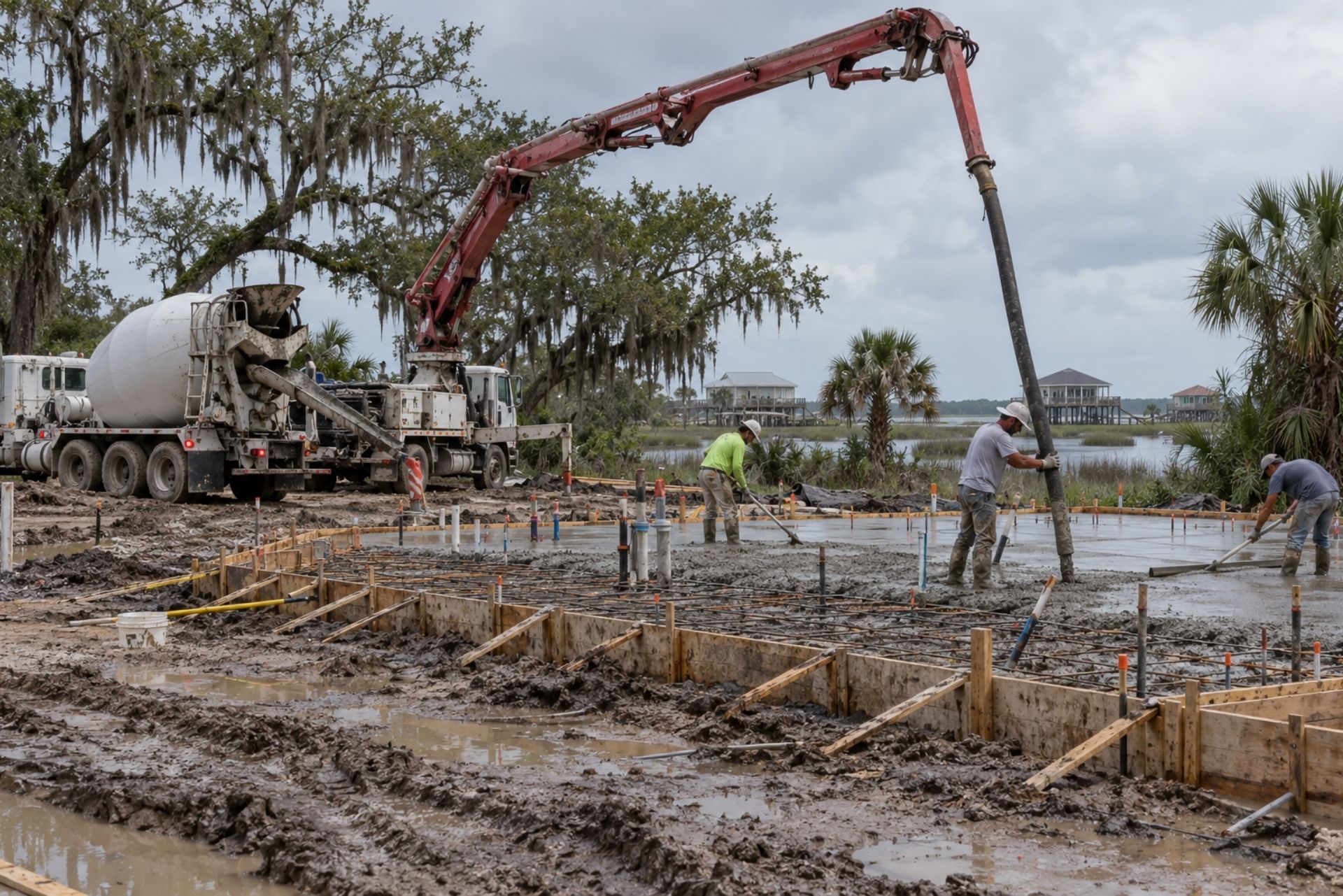
A concrete pump truck can cost more than the house it's pouring a foundation for. Boom failures, outrigger collapses on soft ground, and hose whips that strike workers are the claims that keep underwriters cautious. Louisiana's soft soils make outrigger placement a real exposure, especially on new subdivisions where fill hasn't fully compacted.


Ready-mix operations face their own scrutiny. The market increasingly treats them under a "trucking-first" approach, where commercial auto becomes the dominant line and MCS-90 endorsements are mandatory. If you own mixer trucks, expect your auto premium to outweigh your general liability.

Auto Liability vs. General Liability for Mobile Equipment

This is where claims get messy. Commercial auto typically covers a pump truck driving down Highway 190. General liability may cover it once it's parked and operating as mobile equipment. But the line between the two isn't always clean.


Consider a boom that swings into a power line while the truck is stationary. Some auto policies may cover "loading and unloading" operations, while some GL policies may exclude any vehicle subject to motor vehicle registration. If neither policy clearly picks up the claim, you're stuck in the middle. Make sure both policies are reviewed together, ideally by the same agent, so the gap gets closed before a claim tests it.

The roof

Age, material and shape drive the wind rate more than any other factor. A fortified roof designation opens markets that would otherwise decline the house.

Scenario Dwelling limit All-other-perils deductible Named-storm deductible
Newer build, inland St. Tammany $350,000 $1,000 2%
Newer build, higher wind zone $350,000 $1,000 5%
Older home, updated roof $275,000 $2,500 2%
Older home, original roof $275,000 $2,500 5%
Fortified roof designation $400,000 $1,000 2%
Rebuilt after a prior claim $400,000 $2,500 5%
Bundled with auto $350,000 $1,000 2%

Exact terms vary by carrier, so treat this as a starting point for comparing quotes.

Insurance Requirements for Post-Tension Work

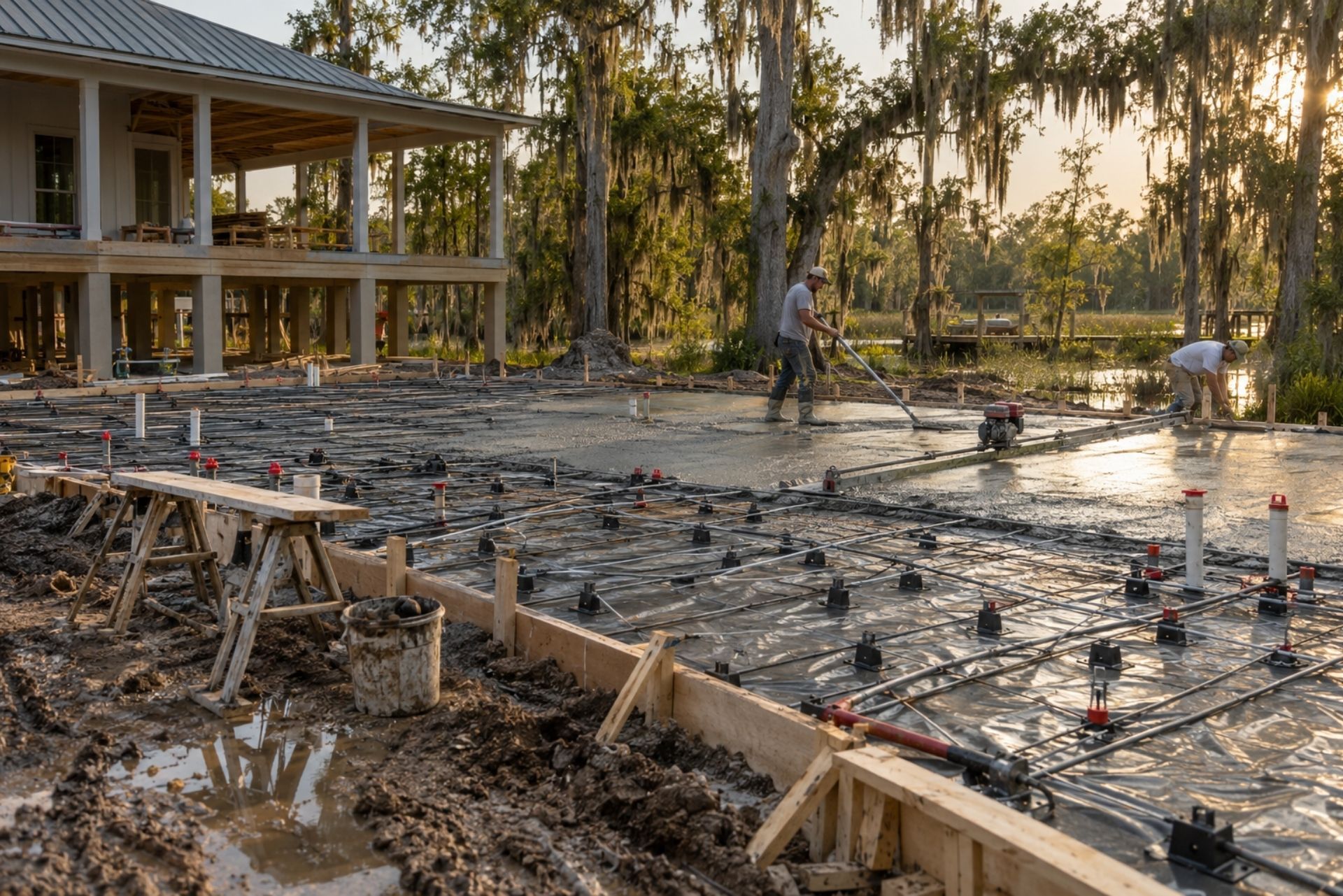
Post-tension slabs are common across St. Tammany Parish because they handle soil movement better than conventional reinforced slabs. That same engineering creates insurance problems. Tendons are stressed to thousands of pounds of force, and a failure during stressing or a later cut by a plumber can cause serious injury and structural damage.


Generic artisan contractor policies often exclude post-tension work entirely. Specialized coverage is available for concrete contractors doing this work, written specifically to address those exclusions. If you add post-tension to your services and don't tell your carrier, you may be uninsured for the riskiest part of the job.


Before your first post-tension pour, confirm a few things:


  1. Your policy classification lists post-tension or structural concrete work
  2. No "designated operations" exclusion names tendon stressing
  3. Your workers' comp class code fits stressing crews
  4. Subcontracted stressing crews carry their own certificates, verified directly


That last point matters given the state's recent focus on fake COIs. Call the issuing agency to confirm the policy is real and active.

Working capital matters more than almost anything else. Underwriters look at current assets minus current liabilities, because cash and receivables are what keep a job moving when a payment runs late. Equity in equipment or real estate helps, but it doesn't pay a subcontractor on Friday.


Expect requests for CPA-prepared financial statements once you seek larger limits. Personal credit counts heavily for smaller firms, since owners typically sign personal indemnity. Clean books, a solid bank line of credit, and low debt can raise your capacity faster than any sales pitch.

Understanding Completed Operations and Construction Defects

Completed operations coverage protects you after the job is finished and handed over. In concrete work, most of the expensive claims land here: a driveway that heaves into a garage door, a patio that pulls away from the house, a commercial floor that cracks under forklift traffic.


Louisiana's construction defect exposure can stretch for years after completion. If your policy limits completed operations to a short window, or if you let coverage lapse when you change carriers, a claim on a 2023 job could arrive with no policy to answer it.


A few common mistakes we see:


  • Switching to a policy with lower premiums that carries a "prior work" exclusion
  • Assuming the aggregate limit for completed operations is separate when it isn't
  • Not asking whether "damage to your work" is covered when subcontractors performed part of it


Watch your cancellation timelines, too. As of July 1, 2026, admitted insurers must give at least 60 days' written notice before canceling or non-renewing, while surplus lines carriers must provide at least 30 days' notice for cancellations. That gives you a window to replace coverage without a gap.

The roof

Age, material and shape drive the wind rate more than any other factor. A fortified roof designation opens markets that would otherwise decline the house.

Comparing Concrete Contractor Coverage Options

Not every concrete business needs every endorsement. A small flatwork crew pouring sidewalks has different exposure than a company designing post-tension foundations or washing out mixer drums on site.

Feature Basic General Liability GL + Professional Liability GL + Pollution Endorsement
Bodily injury to third parties Typically covered Typically covered Typically covered
Design or engineering errors Usually excluded May be covered Usually excluded
Concrete washout runoff Usually excluded Usually excluded May be covered
Slab mix specification mistakes Often excluded May be covered Often excluded
Admixture or chemical spills Usually excluded Usually excluded May be covered
Best fit for Small flatwork crews Design-build, PT layout Ready-mix, large sites

Many Louisiana concrete operations end up in the surplus lines market because of soil and post-tension exposure. Starting July 1, 2026, those policies are reported through SLIP+ with a 0.175% transaction fee on taxable premiums. It's a small line item, but worth knowing when comparing quotes.

Frequently Asked Questions About Louisiana Concrete Insurance

Does my general liability policy cover a cracked slab? Often it doesn't cover the slab itself, especially if the cause is soil settling. It may cover damage the crack causes to other property, depending on your earth movement wording.


How much general liability do I need for residential concrete work? Starting August 1, 2026, residential and home improvement contractors must carry at least $500,000. Many builders and general contractors will ask for higher limits in their subcontracts.


Is my pump truck covered under auto or general liability? It depends on whether the truck is driving or operating. Review both policies together so there's no gap during setup and pumping.


Do I need special coverage for post-tension slabs? Usually, yes. Many standard concrete policies exclude post-tension work, so you'll typically need a policy or endorsement that specifically includes it.


What happens if my insurance classification is wrong? Beyond claim denials, the licensing board can suspend or revoke your license if your policy doesn't reflect the work you actually perform.


How long after a job can someone file a claim against me? Defect claims can show up years later. Continuous completed operations coverage is the main protection.

The roof

Age, material and shape drive the wind rate more than any other factor. A fortified roof designation opens markets that would otherwise decline the house.

Bond Type Who Requires It 2026 Amount What It Guarantees
Contractor License LSLBC $10,000 Compliance with licensing law
Permit Bond Parish or city Varies by jurisdiction Work meets local codes
Bid Bond Public owner Set by bid documents You'll sign if awarded
Performance Bond Public owner Set by contract Project gets completed
Notary (non-attorney) Secretary of State $50,000 Lawful notarial acts
Motor Vehicle Dealer State licensing Confirm with regulator Lawful title and sales handling

Making the Right Choice for Your Concrete Business

Louisiana concrete contractors face a specific set of risks: soils that move, equipment that straddles auto and liability coverage, post-tension work that generic policies may exclude, and defect claims that arrive long after the pour. The right policy isn't the one with the lowest premium. It's the one whose exclusions you've read and whose classification matches what your crews actually do.


That's where an independent agency helps. Aubert Insurance Agency shops multiple carriers and walks you through exclusion language so you know exactly what you're buying. They've been part of the Covington and Slidell community since 1910, insuring local businesses through every storm and market shift.


Bring your current policy, your scope of work, and your equipment list. Start a Quote with Aubert Insurance Agency in Covington or Slidell, and get coverage built for Louisiana ground before your next slab goes in.

About the Author

Kyle Beerbohm

President


We've been independent since 1910, and four generations of local ownership have kept us that way. We're one of the oldest agencies in St. Tammany Parish and the fourth oldest business in the City of Covington. I treat that history as a responsibility rather than a plaque on the wall. My job is to keep us answering to the families and business owners who walk through our doors, and to keep serving this parish for another hundred years.

Louisiana Insurance Questions, Answered

Questions clients ask us

Short, plain answers to what people ask before they call. Anything else, phone the office and ask.

  • What does an independent insurance agency do?

    We represent you, not one insurance company. We gather your information once, then compare coverage and price across the carriers we hold contracts with. You get choices, and one agent handles the paperwork.

  • Which types of insurance does Aubert offer?

    We write 13 personal lines, including home, auto, flood, boat, and life. We write 15 commercial lines, including business owners policies, general liability, workers compensation, and commercial property.

  • Do I need flood insurance in St. Tammany Parish?

    Your homeowners policy excludes flood, and much of the Northshore has flooded outside mapped high-risk zones. Lenders require it inside those zones. We check your flood zone and quote NFIP and private options.

  • Which states are you licensed in?

    We hold licenses in Louisiana, Mississippi, Florida, and Texas. License numbers appear in the footer of every page on this site.

  • How do you find me a competitive rate?

    We take your details once and market them to the carriers and wholesale brokers that fit your risk. We compare the offers, explain the differences in coverage, and recommend the strongest fit.

  • How do I file a claim or request a certificate?

    Call the office or use the Client Center on this site. We report the claim, follow the adjuster, and send certificates of insurance to whoever needs them.

Personal Insurance in Louisiana

Coverage for your home, your vehicles, and your family

Thirteen personal lines sit under one roof. Start with the coverage you need most, and we price it across our markets.

Home Insurance

Protect your house, its contents, and your liability with a policy priced across many Louisiana homeowners carriers.

Car Insurance

Cover every driver and vehicle in your household, and compare limits and deductibles side by side before you buy.

Flood Insurance

Standard home policies exclude flood. We write NFIP and private flood coverage for St. Tammany Parish properties.

Umbrella Insurance

Add a layer of liability above your home and auto limits, so one serious claim never reaches your savings.


Boat Insurance

Cover your hull, motor, trailer, and liability on the lake, the river, and the Gulf, wherever you launch.


Life Insurance

Replace your income for the people who depend on it, with term and permanent options we quote across carriers.

Business Insurance in Louisiana

Coverage for the business you built

Fifteen commercial lines, written for the payrolls, fleets, and buildings that Louisiana carriers ask hard questions about.

Business Insurance by Industry

We protect hundreds of businesses of all shapes and sizes

We know the exposures, the contract language, and the markets that write these trades on the Northshore.

General Contractors

Builders risk, general liability, and comp for homebuilders and remodelers working across St. Tammany Parish.

Plumber Insurance

Plumbers, electricians, roofers, and painters get liability, tools, and auto coverage that satisfies job requirements.

Restaurants

Property, liquor liability, spoilage, and comp for kitchens, bars, and cafés, including Louisiana association programs.

5-Star Rated by St. Tammany Clients

What Our Clients Say

Neighbours, business owners, and families across Covington and Slidell tell the story better than we can.

Insurance Tips & Local News

Insurance tips for Louisiana homes and businesses

Practical reading on flood zones, hurricane deductibles, and the coverage questions local business owners raise.

louisiana citizens homeowners insurance what you need to know
15 October 2026
Learn about Louisiana Citizens homeowners insurance costs, coverage, eligibility, and switching to private insurers with Aubert Insurance Agency.

certificate of insurance requirements for louisiana subcontractors
15 October 2026
Learn Louisiana subcontractor COI requirements, liability limits, additional insured endorsements, and waivers of subrogation with Aubert Insurance Agency.

general liability cost for louisiana contractors
15 October 2026
Learn Louisiana contractor general liability insurance costs by trade, payroll, sales, and minimum premiums. Compare quotes with Aubert Insurance Agency.

louisiana fortify homes program insurance discount
15 October 2026
Explore Louisiana Fortify Homes Program grants up to $10,000, FORTIFIED roof standards, and insurance premium credits with Aubert Insurance Agency.

how does builders risk insurance work in louisiana
15 October 2026
Learn how Louisiana builders risk insurance protects spec and custom homes, who buys coverage, when it ends, and storm risks with Aubert Insurance Agency.

what is the lhba general liability trust
15 October 2026
Explore the LHBA General Liability Trust in Louisiana, how pooled coverage works, builder eligibility, dividends, and risks with Aubert Insurance Agency.

what is the homebuilders self insurers fund
15 October 2026
Explore Louisiana's Homebuilders Self Insurers Fund, how workers comp coverage works, membership eligibility, dividends, and risks with Aubert Insurance Agency.

workers comp cost for louisiana contractors
15 October 2026
Learn Louisiana contractor workers comp costs, class codes, payroll rates, experience mods, and audit risks. Compare quotes with Aubert Insurance Agency.

who needs workers comp in louisiana
15 October 2026
Learn who needs workers comp in Louisiana, including employer rules, owner exemptions, subcontractor risks, and penalties with Aubert Insurance Agency.

louisiana contractor license insurance requirements
15 October 2026
Learn Louisiana contractor insurance requirements for residential, home improvement, and commercial licenses. Compare coverage with Aubert Insurance Agency.


Request Your Free Insurance Quote

Tell us what you need covered

Send the form or call the office. A licensed agent in Covington or Slidell answers you directly.

614 E. Boston St., Covington, LA 70433.  (985) 892-3101

58418 Tyler Drive, Slidell, LA 70461 ·   (985) 641-0520

Call

Covington office, Monday through Friday

Email

Policy questions, certificates, and claims

Call

614 E. Boston St., Covington, LA 70433

58418 Tyler Drive, Slidell, LA 70461
