

Covington & Slidell Independent Insurance Agents
Protecting Your Assets with a Business Owners Policy
MNot every BOP is built the same. These features deserve a close look before you sign:
Equipment breakdown: May cover electrical or mechanical failure, like a power surge frying an imaging machine's circuit board. Standard property forms often exclude this.
Business income: Typically replaces lost revenue and continuing expenses if a covered loss forces you to close temporarily.
Spoilage coverage: May pay for vaccines or medications lost when refrigeration fails during an outage.
Flood: Usually excluded from a BOP. Practices in flood-prone parts of St. Tammany often need a separate flood policy.
Named storm deductibles: Louisiana policies frequently carry percentage-based hurricane deductibles, so know the dollar figure before storm season.
Hammond sits on flat, low ground between two rivers that have shown what they can do. A Zone X label on your property map may make flood coverage look optional, but the water in 2016 did not check anyone's map first. Below is a practical look at local flood risk, what coverage typically costs to put in place, and what to do when a lender letter shows up.
Hammond LA Flood Insurance: Protecting Your Home from Local Risks
Hammond homeowners face two separate flood threats: rivers like the Natalbany and Tangipahoa overflowing their banks, and heavy rain ponding on flat ground with nowhere to drain. Either one can put water in your living room. Flood coverage makes sense whether your map says high-risk Zone AE or moderate-to-low-risk Zone X.
Standard homeowners policies in Louisiana typically exclude flood damage. That exclusion surprises people more than almost anything else we explain. Rising water that enters from outside is usually a flood claim, and it needs a separate flood policy through the National Flood Insurance Program (NFIP) or a private carrier.
Timing matters too. NFIP policies generally carry a 30-day waiting period before coverage starts. If you wait until a tropical system shows up in the Gulf forecast, you are probably too late for that storm.
Some local context helps. Tangipahoa Parish is currently a Class 8 community in FEMA's Community Rating System, which gives policyholders in Special Flood Hazard Areas a 10% reduction on NFIP premiums. That helps, but it does not make the risk disappear.
On this page
Aubert Insurance Agency is a local, independent agency, licensed to serve individuals and businesses across Louisiana, Mississippi, Florida and Texas.
We serve clients from our offices in Covington and Slidell and throughout St. Tammany Parish — working with dozens of carriers and wholesale markets to help homeowners, drivers, contractors, restaurant owners, property investors, auto shops, professional practices and many other personal and commercial clients find coverage that fits.
Licensed in Louisiana #3661 · Mississippi #15039075 · Florida #W0772236 · Texas #2381820
Understanding the Named Storm Deductible
A named storm deductible works differently than the flat $500 or $1,000 deductible on your regular claims. In Louisiana, it's often calculated as 2% to 5% of the insured value of your personal property. On a policy with $40,000 in contents coverage, a 5% deductible means the first $2,000 of a hurricane loss is yours.
There's some good news in state law. Louisiana's one-deductible-per-year rule (La. R.S. 22:1337) means you generally pay the named storm deductible only once per calendar year, even if two storms hit your rental. Ask your agent to show you that deductible in dollars, not just a percentage, so you can set aside the right amount in an emergency fund.
Lessons from the Natalbany and Tangipahoa River Flooding in 2016
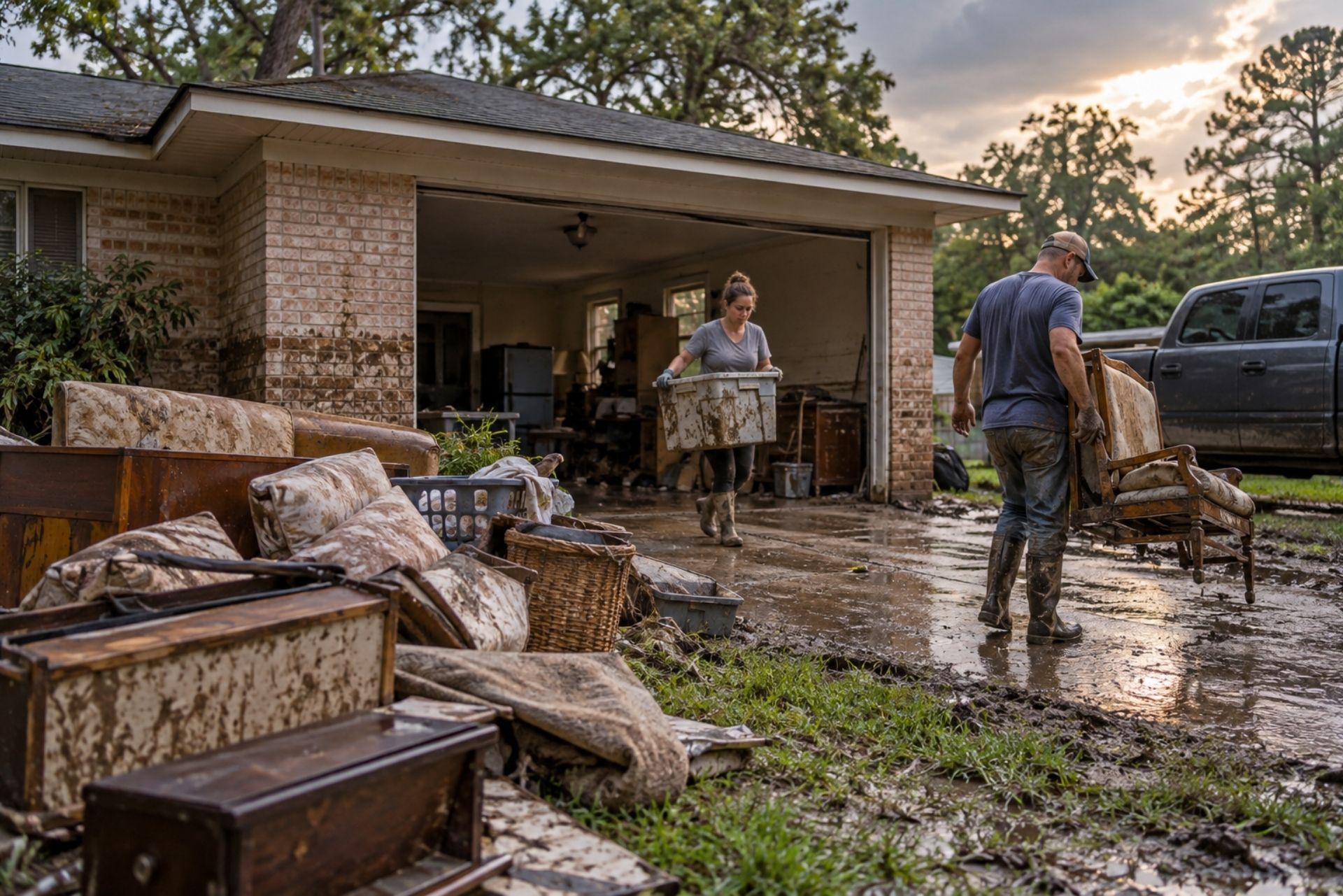
The August 2016 flood is the event most Hammond families still measure everything against. A slow-moving rain system parked over southeast Louisiana for days, and the Natalbany and Tangipahoa rivers climbed to record levels. Water reached neighborhoods that had never flooded in living memory.
The painful part was who got hit. Many of the flooded homes sat outside high-risk zones, so their owners had never been required to buy flood insurance. Plenty of them had never even been offered it. When the water went down, those families were left with FEMA disaster assistance, which is typically limited, or loans they had to repay.
Here is what 2016 taught us about local risk:
- Record events break old assumptions. Maps reflect past data, and rivers do not read maps.
- Backwater spreads far. When main rivers rise, smaller tributaries and drainage canals back up into areas miles from the riverbank.
- Uninsured recovery is slow. Homeowners with flood policies generally started rebuilding sooner than those waiting on grants.
If your home stayed dry in 2016, that is good news. It is not a guarantee about the next storm.
With no lender to satisfy, the decision is yours, and so is the entire loss. A total rebuild in this parish runs well into six figures.
Homeowners who own outright
Your lender requires coverage at least equal to the loan, and will buy a policy on your behalf at your expense if yours lapses.
Homeowners with a mortgage
Being named as a certificate holder just means someone receives proof. Being named as an additional insured means your policy may actually defend and pay for that party if they're sued because of your work. General contractors, developers, and property managers ask for this because they get pulled into lawsuits over subcontractor mistakes constantly.
Read the contract language closely. Some agreements require "primary and noncontributory" wording or completed operations coverage for the additional insured, which needs specific endorsements. Many contractors sign a subcontract agreeing to these terms without checking whether their policy includes them. If a claim comes in and the endorsement isn't there, you may be in breach of contract on top of facing the lawsuit.
Ponding in Flat Inland Subdivisions
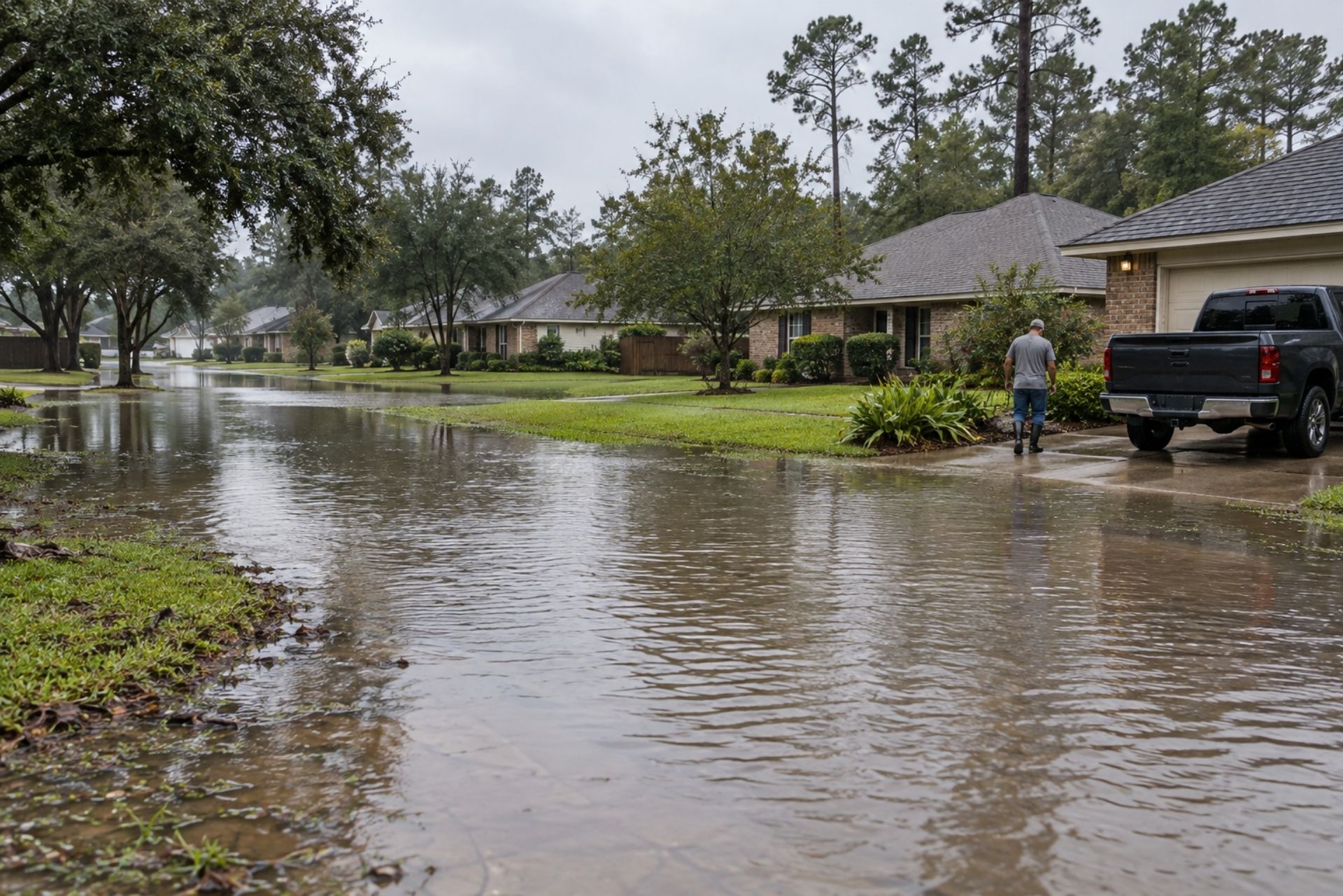
You do not need a river in your backyard to flood in Hammond. The terrain here is very flat, and many subdivisions built over the past few decades sit on ground with very little slope. When several inches of rain fall in a few hours, storm drains and roadside ditches fill faster than they can empty.
The result is ponding. Water collects in streets, yards and low spots, then creeps toward slab foundations. It might only be two or three inches deep inside the house, but that is enough to ruin flooring, baseboards, drywall, cabinets and anything stored on the floor.
We see a common mistake with these claims. Homeowners assume their homeowners policy will pay because the water came from rain, not a river. In most cases, surface water entering the home is treated as flood, which homeowners policies typically exclude. A flood policy is usually what responds.
A few practical steps can lower your exposure:
- Keep curbside drains clear of leaves and debris before storm season.
- Check that your yard grades away from the slab.
- Store valuables and documents off the floor in closets and garages.
- Photograph your rooms now so you have a pre-loss record if you ever file a claim.
The roof
Age, material and shape drive the wind rate more than any other factor. A fortified roof designation opens markets that would otherwise decline the house.
Evaluating Wind and Tree Exposure Risks
Pine and oak trees are part of why people love living in the Pearl River area. They're also a leading cause of roof claims after tropical storms and severe thunderstorms. A single limb through a roof can open the house to water damage that runs far beyond the cost of the roof repair.
Carriers have noticed. In 2026, more insurers are making trimming of limbs that touch or hang over a roof a condition of renewal. A drive-by or aerial inspection may flag overhanging branches, and you could receive a notice giving you a deadline to fix it. Ignoring that letter can lead to nonrenewal, which makes finding new coverage harder.
The roof itself is the other half of the wind picture. Louisiana offers incentives for stronger roofs, and the state's wind mitigation program details explain how certain construction features can lower your premium. Beginning January 1, 2027, Louisiana insurers must apply a premium reduction of 16% to 49% to the hurricane portion for homes with a certified FORTIFIED roof. If you're planning a roof replacement anyway, it may make sense to price out FORTIFIED certification at the same time.
Also review your named storm or wind deductible. In this part of Louisiana, it's often a percentage of the dwelling limit rather than a flat dollar amount, so a 5% deductible on a $250,000 home means $12,500 out of pocket.
Your belongings
Personal property covers furniture, clothing, tools and electronics. Jewellery, firearms and silver carry low internal caps, so we schedule those items separately when they are worth more than the cap.
Farm Equipment and Machinery Protection
Tractors, bush hogs, UTVs, and zero-turn mowers are where a lot of Pearl River landowners find gaps. Personal property coverage on a homeowners policy may cover some yard equipment, but it often limits or excludes motorized vehicles and items used for farming or business purposes.
Options depend on how you use the equipment:
- Hobby or property maintenance use: An endorsement or scheduled item on the homeowners policy may work.
- Small-scale farming or hay production: A farm or ranch policy, or an inland marine/equipment floater, typically fits better.
- Off-road vehicles like UTVs: These often need their own policy, especially if driven off your property.
Keep serial numbers and photos of every machine. Theft of tractors and trailers from rural lots is a real claim type, and documentation speeds up recovery.
Low-Cost Zone X Policies
Zone X is FEMA's label for moderate-to-low flood risk areas. Properties here are generally not required by lenders to carry flood coverage, which is why so many Hammond homeowners skip it. That is often a mistake.
Nationally, a significant share of NFIP flood claims comes from properties outside high-risk zones. The 2016 flood made that point locally in a very personal way. Zone X homes flood less often than Zone AE homes, but when they do, the damage can be just as expensive to repair.
The upside is that coverage for Zone X properties is often affordable. Under FEMA's Risk Rating 2.0 pricing, premiums now depend on property-specific factors such as distance to water, elevation and rebuilding cost, not just the zone letter. For many Zone X homes, that still works out to a modest annual premium.
Pricing has not been gentle everywhere. Tangipahoa Parish President Robby Miller has criticized the system, saying
some individual premiums jumped from $600 to as much as $6,000. That is exactly why comparing NFIP and private flood options side by side matters. Some private carriers may offer different limits or pricing for lower-risk homes.
| Feature | Basic Coverage | Extended Coverage |
|---|---|---|
| Property valuation | Actual cash value (depreciated) | Replacement cost (new item price) |
| Liability limit | $100,000 | $300,000 to $500,000 |
| Valuables (jewelry, guns, art) | Low sublimits, often $1,500 or less | Scheduled items at appraised value |
| Water backup from drains | Usually excluded | May be added by endorsement |
| Loss of use | Limited dollar cap | Higher cap or longer timeframe |
| Flood | Not covered | Still not covered (needs NFIP or private flood) |
| Named storm deductible | Percentage applies | Percentage applies, sometimes lower options |
How coverage choices change a Louisiana homeowners premium. Structure only — your rate depends on your property. [CONFIRM figures]
How coverage choices change a Louisiana homeowners premium. Structure only — your rate depends on your property. [CONFIRM figures]
| Scenario | Dwelling limit | All-other-perils deductible | Named-storm deductible |
|---|---|---|---|
| Newer build, inland St. Tammany | $350,000 | $1,000 | 2% |
| Newer build, higher wind zone | $350,000 | $1,000 | 5% |
| Older home, updated roof | $275,000 | $2,500 | 2% |
| Older home, original roof | $275,000 | $2,500 | 5% |
| Fortified roof designation | $400,000 | $1,000 | 2% |
| Rebuilt after a prior claim | $400,000 | $2,500 | 5% |
| Bundled with auto | $350,000 | $1,000 | 2% |
Notice how none of these overlap much. A patient injured by a falling ceiling tile is a general liability issue, while a patient harmed by a medication error belongs to malpractice. Having one policy does not fill the hole another leaves.
The employee row trips up more owners than any other. Your own techs get hurt far more often than customers do, and neither garage coverage pays for those injuries. Workers' compensation does.
| Scenario | Garage Liability | Garagekeepers |
|---|---|---|
| Lift fails, customer car falls | Usually no (car is in your care) | Typically yes |
| Lift fails, injures a visiting customer | Typically yes | No |
| Test drive hits another vehicle | Typically yes (other car, injuries) | May cover customer's car |
| Customer slips on oil in the bay | Typically yes | No |
| Employee injured under a lift | No (workers' comp) | No |
| Flood damages stored customer car | No | May apply, depending on form |
| Faulty repair causes later crash | Typically yes (completed operations) | No |
| General Liability | Professional Liability (Malpractice) | Cyber Liability | |
|---|---|---|---|
| Main purpose | Injuries and property damage on premises | Errors in patient care | Data breaches and cyberattacks |
| Example claim | Patient trips over a cord in the hallway | Missed diagnosis leads to a lawsuit | Ransomware exposes patient files |
| Typical source | Included in a BOP | Separate malpractice policy plus PCF | Standalone or endorsement |
| Louisiana twist | Standard commercial rules | $100,000 primary layer, PCF above | HIPAA and breach notification duties |
| Common gap | Excludes treatment-related injuries | Excludes data breach costs | May exclude losses from weak security |
Notice how none of these overlap much. A patient injured by a falling ceiling tile is a general liability issue, while a patient harmed by a medication error belongs to malpractice. Having one policy does not fill the hole another leaves.
Louisiana Minimum Liability vs. Full Coverage
Carrying the state minimum keeps you legal and protects you from No Pay No Play. It does not protect your car or cover significant injury claims. "Full coverage" isn't an official term, but it usually means liability plus collision and comprehensive.
Covington and Slidell are full of people who serve on church councils, school foundations, hospital boards, and civic groups. Louisiana provides real protection here. Under R.S. 9:2792.1, uncompensated directors and officers of 501(c) nonprofits are generally not individually liable for acts or omissions within their official duties if acting in good faith.
That protection has limits. It typically won't help with claims of gross negligence, and it doesn't apply if you're paid for your service. For-profit board seats are a different story entirely: most personal umbrellas exclude them unless a specific endorsement is added. Even with nonprofit boards, confirm the organization carries its own D&O policy, and ask whether your umbrella may offer excess nonprofit D&O coverage on top.
Not every claim starts with a collision. Comprehensive coverage handles damage from things other than hitting another car or object, and in Hammond that list is long.
Theft and Vandalism
Vehicle theft, break-ins, and vandalism also generally fall under comprehensive. Parked cars in apartment complexes and around campus can be targets. Keep in mind that personal items stolen from inside the car are usually covered by renters or homeowners insurance, not your auto policy.
One thing to watch is your deductible. A high comprehensive deductible lowers your premium but may make smaller windshield or hail claims not worth filing.
Will my insurance cover roof damage from a future hurricane?
Usually yes, if wind is included in your policy, but how much it pays depends on your hurricane deductible and whether the roof is covered at ACV or RCV. Check your declarations page for a separate named storm deductible, which is often a percentage of your dwelling limit.
Flood Zone Comparison at a Glance
| Feature | Zone X (Moderate/Low Risk) | Zone A / AE (High Risk) |
|---|---|---|
| Lender requirement | Usually not required | Required with federally backed mortgage |
| Typical premium | Often lower | Generally higher, varies by elevation |
| Flood risk | Lower, but real | Higher, 1% or greater annual chance |
| Ponding exposure | Common in flat subdivisions | Common, plus riverine risk |
| CRS premium reduction | Limited or none | 10% in Tangipahoa Parish (Class 8) |
| Private flood options | Often available | Available, may vary by property |
The takeaway: the zone affects price and requirements, but both columns can flood.
The roof
Age, material and shape drive the wind rate more than any other factor. A fortified roof designation opens markets that would otherwise decline the house.
Evaluating Wind and Tree Exposure Risks
Pine and oak trees are part of why people love living in the Pearl River area. They're also a leading cause of roof claims after tropical storms and severe thunderstorms. A single limb through a roof can open the house to water damage that runs far beyond the cost of the roof repair.
Carriers have noticed. In 2026, more insurers are making trimming of limbs that touch or hang over a roof a condition of renewal. A drive-by or aerial inspection may flag overhanging branches, and you could receive a notice giving you a deadline to fix it. Ignoring that letter can lead to nonrenewal, which makes finding new coverage harder.
The roof itself is the other half of the wind picture. Louisiana offers incentives for stronger roofs, and the state's wind mitigation program details explain how certain construction features can lower your premium. Beginning January 1, 2027, Louisiana insurers must apply a premium reduction of 16% to 49% to the hurricane portion for homes with a certified FORTIFIED roof. If you're planning a roof replacement anyway, it may make sense to price out FORTIFIED certification at the same time.
Also review your named storm or wind deductible. In this part of Louisiana, it's often a percentage of the dwelling limit rather than a flat dollar amount, so a 5% deductible on a $250,000 home means $12,500 out of pocket.
Your belongings
Personal property covers furniture, clothing, tools and electronics. Jewellery, firearms and silver carry low internal caps, so we schedule those items separately when they are worth more than the cap.
Farm Equipment and Machinery Protection
Tractors, bush hogs, UTVs, and zero-turn mowers are where a lot of Pearl River landowners find gaps. Personal property coverage on a homeowners policy may cover some yard equipment, but it often limits or excludes motorized vehicles and items used for farming or business purposes.
Options depend on how you use the equipment:
- Hobby or property maintenance use: An endorsement or scheduled item on the homeowners policy may work.
- Small-scale farming or hay production: A farm or ranch policy, or an inland marine/equipment floater, typically fits better.
- Off-road vehicles like UTVs: These often need their own policy, especially if driven off your property.
Keep serial numbers and photos of every machine. Theft of tractors and trailers from rural lots is a real claim type, and documentation speeds up recovery.
Seeing the coverages side by side makes the value of extended protection easier to judge.
Lender Letters After Remapping
FEMA periodically updates flood maps as it collects new elevation and rainfall data. When a new map takes effect, some Hammond properties move from Zone X into a high-risk zone. The homeowner usually finds out through a letter from their mortgage servicer, not from FEMA.
Why Did I Get a Letter from My Lender?
Federally backed and federally regulated lenders must require flood insurance on properties in Special Flood Hazard Areas. When a remapping places your home inside one of those areas, the lender is obligated to notify you. The letter will typically ask you to show proof of flood coverage within a set period, often 45 days.
Do not ignore it. If you do nothing, the lender can buy force-placed flood insurance on your behalf and add the cost to your escrow. Force-placed coverage is usually more expensive and generally protects the lender's interest in the structure, not your belongings.
How New Flood Maps Impact Your Mortgage
A new flood requirement usually raises your monthly payment through escrow. If you were already carrying a voluntary Zone X policy before the map change, that history may help with pricing, so ask about it.
You also have options. If you believe the map is wrong, a licensed surveyor can prepare an Elevation Certificate, and you may be able to apply to FEMA for a Letter of Map Amendment. Parish efforts matter here too. The Tangipahoa Parish Council adopted Resolution R-26-26 in September 2026 to formalize a flood prevention outreach program aimed at keeping or improving insurance savings. Louisiana's CRS participation is coordinated through the DOTD to help communities lower flood premiums, and nearby St. Charles Parish reached a Class 6 rating in October 2026. Higher classes generally mean larger premium reductions for residents.
Common Questions About Hammond Flood Coverage
Does my homeowners policy cover flooding in Hammond? Usually not. Most homeowners policies exclude rising water, so you typically need a separate flood policy.
I'm in Zone X. Do I really need flood insurance? You are not usually required to buy it, but Zone X homes in Hammond flooded in 2016. Coverage is often affordable and can protect you from a costly uninsured loss.
How long before a new flood policy kicks in? NFIP policies generally have a 30-day waiting period. Some private flood policies may have shorter waits, depending on the carrier.
My lender says I need flood insurance after a map change. What now? Get a quote quickly and send proof of coverage before the deadline in the letter. Waiting can lead to force-placed coverage at a higher cost.
Does flood insurance cover my furniture and belongings? Only if you add contents coverage. Building coverage and contents coverage are typically separate parts of the policy.
Can I lower my flood premium? Possibly. An Elevation Certificate, flood vents, raising utilities or comparing private carriers may reduce your cost..
The roof
Age, material and shape drive the wind rate more than any other factor. A fortified roof designation opens markets that would otherwise decline the house.
Evaluating Wind and Tree Exposure Risks
Pine and oak trees are part of why people love living in the Pearl River area. They're also a leading cause of roof claims after tropical storms and severe thunderstorms. A single limb through a roof can open the house to water damage that runs far beyond the cost of the roof repair.
Carriers have noticed. In 2026, more insurers are making trimming of limbs that touch or hang over a roof a condition of renewal. A drive-by or aerial inspection may flag overhanging branches, and you could receive a notice giving you a deadline to fix it. Ignoring that letter can lead to nonrenewal, which makes finding new coverage harder.
The roof itself is the other half of the wind picture. Louisiana offers incentives for stronger roofs, and the state's wind mitigation program details explain how certain construction features can lower your premium. Beginning January 1, 2027, Louisiana insurers must apply a premium reduction of 16% to 49% to the hurricane portion for homes with a certified FORTIFIED roof. If you're planning a roof replacement anyway, it may make sense to price out FORTIFIED certification at the same time.
Also review your named storm or wind deductible. In this part of Louisiana, it's often a percentage of the dwelling limit rather than a flat dollar amount, so a 5% deductible on a $250,000 home means $12,500 out of pocket.
Your belongings
Personal property covers furniture, clothing, tools and electronics. Jewellery, firearms and silver carry low internal caps, so we schedule those items separately when they are worth more than the cap.
Farm Equipment and Machinery Protection
Tractors, bush hogs, UTVs, and zero-turn mowers are where a lot of Pearl River landowners find gaps. Personal property coverage on a homeowners policy may cover some yard equipment, but it often limits or excludes motorized vehicles and items used for farming or business purposes.
Options depend on how you use the equipment:
- Hobby or property maintenance use: An endorsement or scheduled item on the homeowners policy may work.
- Small-scale farming or hay production: A farm or ranch policy, or an inland marine/equipment floater, typically fits better.
- Off-road vehicles like UTVs: These often need their own policy, especially if driven off your property.
Keep serial numbers and photos of every machine. Theft of tractors and trailers from rural lots is a real claim type, and documentation speeds up recovery.
Making the Right Choice for Your Property
Hammond's flood story comes down to a few points. The Natalbany and Tangipahoa can rise far beyond what anyone expects. Flat subdivisions pond during heavy rain. Zone X coverage is often affordable, and remapping can turn optional coverage into a lender requirement almost overnight.
The smartest move is to look at your own property instead of relying on the zone letter. Your elevation, drainage, distance to water and what you keep on the ground floor all shape your risk and your price.
Aubert Insurance Agency has been insuring Louisiana homes since 1910. As an independent agency, we compare NFIP and private flood options from multiple carriers and walk you through what each policy covers and excludes, so there are no surprises after a storm. Whether you are in Zone X or just opened a lender letter, review your risk with an agent who knows this area. Start a Quote today, and get coverage in place before the next heavy rain arrives.

About the Author
Kyle Beerbohm
President
We've been independent since 1910, and four generations of local ownership have kept us that way. We're one of the oldest agencies in St. Tammany Parish and the fourth oldest business in the City of Covington. I treat that history as a responsibility rather than a plaque on the wall. My job is to keep us answering to the families and business owners who walk through our doors, and to keep serving this parish for another hundred years.
Louisiana Insurance Questions, Answered
Questions clients ask us
Short, plain answers to what people ask before they call. Anything else, phone the office and ask.
What does an independent insurance agency do?
We represent you, not one insurance company. We gather your information once, then compare coverage and price across the carriers we hold contracts with. You get choices, and one agent handles the paperwork.
Which types of insurance does Aubert offer?
We write 13 personal lines, including home, auto, flood, boat, and life. We write 15 commercial lines, including business owners policies, general liability, workers compensation, and commercial property.
Do I need flood insurance in St. Tammany Parish?
Your homeowners policy excludes flood, and much of the Northshore has flooded outside mapped high-risk zones. Lenders require it inside those zones. We check your flood zone and quote NFIP and private options.
Which states are you licensed in?
We hold licenses in Louisiana, Mississippi, Florida, and Texas. License numbers appear in the footer of every page on this site.
How do you find me a competitive rate?
We take your details once and market them to the carriers and wholesale brokers that fit your risk. We compare the offers, explain the differences in coverage, and recommend the strongest fit.
How do I file a claim or request a certificate?
Call the office or use the Client Center on this site. We report the claim, follow the adjuster, and send certificates of insurance to whoever needs them.

Personal Insurance in Louisiana
Coverage for your home, your vehicles, and your family
Thirteen personal lines sit under one roof. Start with the coverage you need most, and we price it across our markets.
Home Insurance
Protect your house, its contents, and your liability with a policy priced across many Louisiana homeowners carriers.
Car Insurance
Cover every driver and vehicle in your household, and compare limits and deductibles side by side before you buy.
Flood Insurance
Standard home policies exclude flood. We write NFIP and private flood coverage for St. Tammany Parish properties.
Umbrella Insurance
Add a layer of liability above your home and auto limits, so one serious claim never reaches your savings.
Boat Insurance
Cover your hull, motor, trailer, and liability on the lake, the river, and the Gulf, wherever you launch.
Life Insurance
Replace your income for the people who depend on it, with term and permanent options we quote across carriers.
Business Insurance in Louisiana
Coverage for the business you built
Fifteen commercial lines, written for the payrolls, fleets, and buildings that Louisiana carriers ask hard questions about.

Contractors Insurance
General contractors, trade contractors and specialty crews. We cover the liability, tools, vehicles and workers your jobs depend on.

Business Owners (BOP)
One policy bundling property and liability for a small business. Straightforward cover for the building, the contents and the risk.

Professional Liability
Protection when your advice or professional work is challenged. A staple of any commercial package for a service business.

Commercial Property
Landlords and commercial real estate investors. We insure the building, the habitation risk and the income it produces.

Workers Compensation
Protecting your employees protects your business. Medical costs and lost wages covered when someone is hurt on the job.

Commercial Auto
Trucks, vans and fleets. We shop a wide range of commercial auto markets to match your vehicles and your drivers.
Business Insurance by Industry
We protect hundreds of businesses of all shapes and sizes
We know the exposures, the contract language, and the markets that write these trades on the Northshore.

Residential General Contractors
Builders risk, general liability, and comp for homebuilders and remodelers working across St. Tammany Parish.

Trade Contractors
Plumbers, electricians, roofers, and painters get liability, tools, and auto coverage that satisfies job requirements.

Restaurants
Property, liquor liability, spoilage, and comp for kitchens, bars, and cafés, including Louisiana association programs.
5-Star Rated by St. Tammany Clients
What Our Clients Say
Neighbours, business owners, and families across Covington and Slidell tell the story better than we can.
Insurance Tips & Local News
Insurance tips for Louisiana homes and businesses
Practical reading on flood zones, hurricane deductibles, and the coverage questions local business owners raise.










Request Your Free Insurance Quote
Tell us what you need covered
Send the form or call the office. A licensed agent in Covington or Slidell answers you directly.
614 E. Boston St., Covington, LA 70433. (985) 892-3101
58418 Tyler Drive, Slidell, LA 70461 · (985) 641-0520
Visit
614 E. Boston St., Covington, LA 70433 — Get Directions
58418 Tyler Drive, Slidell, LA 70461 — Get Directions


