













Covington & Slidell Independent Insurance Agents
A siding contractor in Louisiana typically needs General Liability and Workers Compensation at a minimum. Many also add Commercial Auto, Inland Marine for tools and pump jacks, and an umbrella policy. Since August 1, 2026, residential and home improvement contractors must carry at least $500,000 in general liability, up from $100,000.
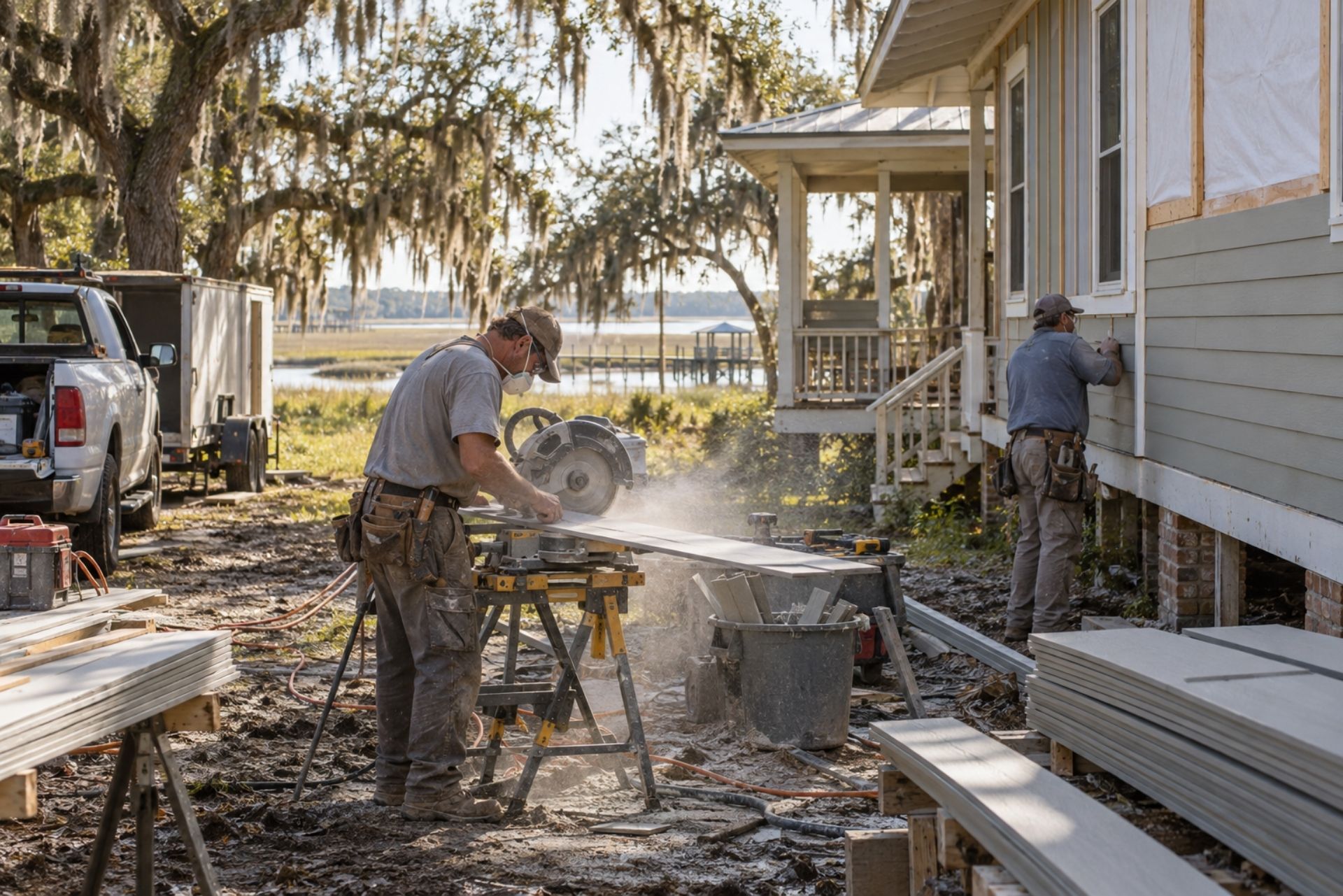
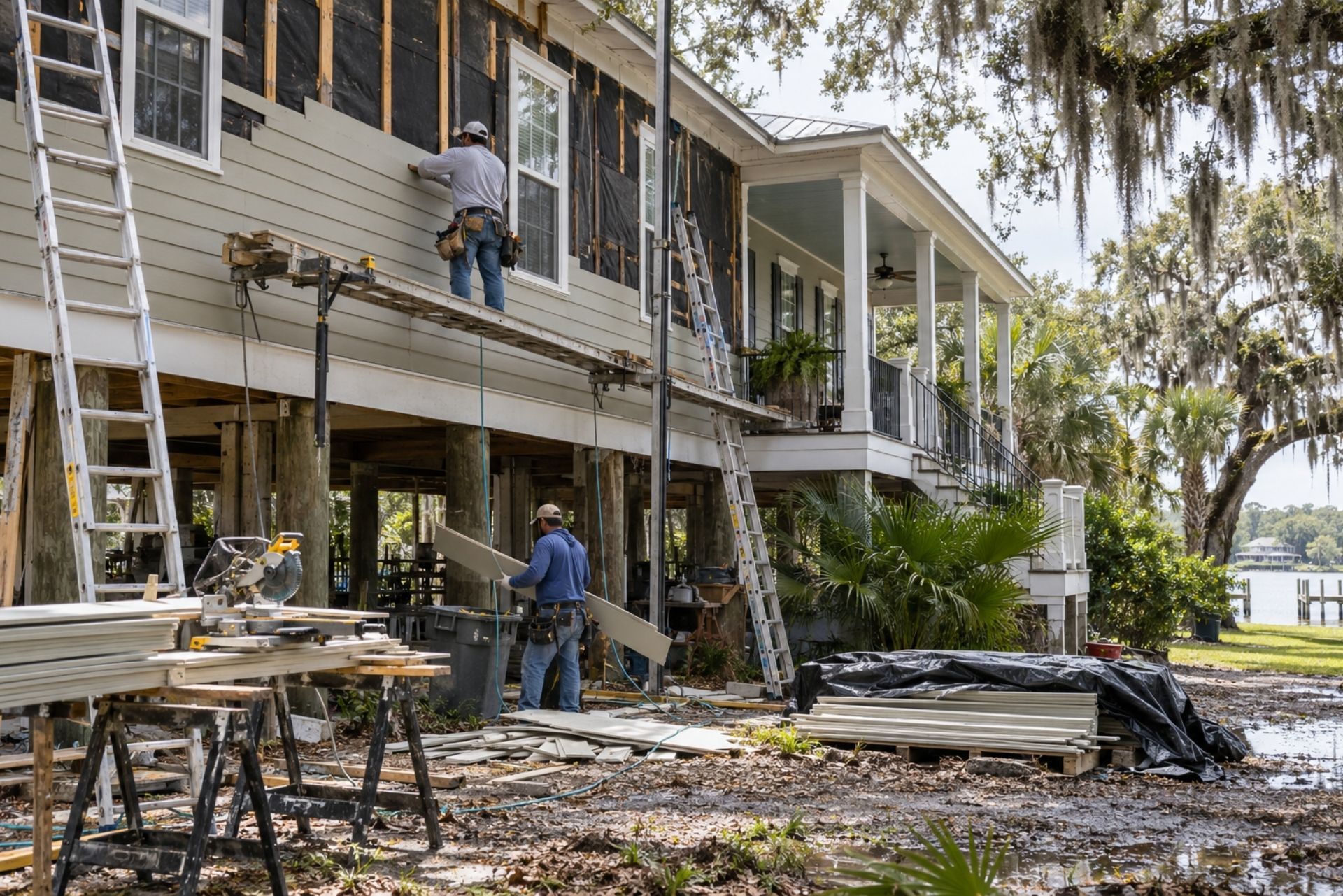
Picture a two-story job in Slidell three weeks after a tropical storm. Your crew is working off pump jacks. A helper is cutting fiber cement on a sawhorse. The homeowner keeps asking whether the new wall will stop the leak that ruined their drywall. Each of those moments carries a different kind of risk, and each one maps to a different part of your policy. Getting Louisiana siding contractor insurance right means knowing which coverage responds to which problem before a claim lands on your desk.
This guide is written for contractors in Covington, Slidell, and across St. Tammany Parish who install, replace, or repair siding. It covers falls from height, moisture claims that surface years later, the chaos of post-storm demand, and silica exposure from cutting cement board. It closes with a coverage comparison and answers to the questions contractors ask most often.
Louisiana Siding Contractor Insurance Requirements and Risks
Louisiana siding contractors typically need General Liability and Workers Compensation to protect against high-risk activities like pump jack use and storm repair. General Liability responds to third-party bodily injury and property damage. Workers Compensation covers your employees' medical bills and lost wages after an on-the-job injury.
The rules tightened considerably in 2026. Under Act 757, the minimum general liability requirement for residential and home improvement contractors rose to $500,000 effective August 1. Contractors must also show proof of coverage for at least six months covering all licensed scopes of work. A policy that lapses mid-year or excludes part of your work can put your license at risk.
Fault rules changed as well. As of January 1, 2026, Louisiana moved to a modified comparative fault system, which bars a plaintiff from recovering if they are found more than 50% at fault. That can help in some injury suits, but it does not replace solid coverage. Defense costs alone can run high before fault is ever decided.

On this page
Aubert Insurance Agency is a local, independent agency, licensed to serve individuals and businesses across Louisiana, Mississippi, Florida and Texas.
We serve clients from our offices in Covington and Slidell and throughout St. Tammany Parish — working with dozens of carriers and wholesale markets to help homeowners, drivers, contractors, restaurant owners, property investors, auto shops, professional practices and many other personal and commercial clients find coverage that fits.
Licensed in Louisiana #3661 · Mississippi #15039075 · Florida #W0772236 · Texas #2381820
Many St. Tammany families end up with both: standalone coverage for the land, plus an umbrella over the home and vehicles.
Comparison: Standalone Liability vs. Umbrella Coverage
Understanding the Named Storm Deductible
A named storm deductible works differently than the flat $500 or $1,000 deductible on your regular claims. In Louisiana, it's often calculated as 2% to 5% of the insured value of your personal property. On a policy with $40,000 in contents coverage, a 5% deductible means the first $2,000 of a hurricane loss is yours.
There's some good news in state law. Louisiana's one-deductible-per-year rule (La. R.S. 22:1337) means you generally pay the named storm deductible only once per calendar year, even if two storms hit your rental. Ask your agent to show you that deductible in dollars, not just a percentage, so you can set aside the right amount in an emergency fund.
| Factor | Standalone Liability | Umbrella Policy |
|---|---|---|
| Underlying policy required | No | Yes, home and auto typically |
| When it pays | First dollar of a covered claim | After underlying limits run out |
| Typical use | Vacant land, hunting tracts, specific risks | Broad extra protection across policies |
| Cost structure | Priced by acreage, use, and limit | Priced by number of homes, cars, drivers |
| Scope | Narrow, tied to named property or risk | Wide, follows underlying coverage |
| Common limits | $300,000 to $1 million | $1 million and up |
People use the two terms as if they mean the same thing. They do not.
A true umbrella policy may provide broader coverage than the policies below it. In some cases it can "drop down" to cover a claim the primary policy excludes, usually subject to a self-insured retention, often $10,000 or $25,000. An excess policy is typically "follow form," which means it copies the terms and exclusions of the underlying policy and simply adds more limit.
Here is why that matters. If your general liability policy excludes a certain type of claim, a follow-form excess policy will generally exclude it as well. Higher limits do not repair a weak foundation. We go through the endorsements on each layer with clients before binding, because the wording on page 14 of the policy is what decides whether a claim gets paid.
Ladder and Pump-Jack Falls: Managing Height Risks
Falls are the claim that keeps siding contractors up at night. A pump-jack plank that slips, a ladder footed on soft soil after a rain, or a bracket that pulls loose from a rotted wall can all send someone to the ground from 15 or 20 feet. Those injuries tend to be serious and expensive.
Workers Compensation is the policy that responds when your own employee falls. In Louisiana, it typically covers medical treatment and a portion of lost wages, and it generally limits the employee's ability to sue you directly. The common mistake we see is a contractor treating regular helpers as 1099 subcontractors to keep payroll low. If that "sub" falls and has no coverage of his own, the claim may come back to you, and your carrier may audit and charge premium for the misclassified payroll anyway.
Third parties are a separate issue. If a homeowner's child walks under your scaffold and a dropped tool hits them, General Liability is the policy that responds. A few practical habits help on both fronts:
- Collect certificates of insurance from every subcontractor before they set foot on site
- Inspect pump-jack poles and brackets at the start of each job and document it
- Tape off the work zone below active scaffolding
- Keep training records for fall protection, since carriers may ask for them after a claim
Your pump jacks, ladders, and planks themselves are equipment. Inland Marine coverage typically protects tools and gear against theft or damage, which General Liability does not.
With no lender to satisfy, the decision is yours, and so is the entire loss. A total rebuild in this parish runs well into six figures.
Homeowners who own outright
Your lender requires coverage at least equal to the loan, and will buy a policy on your behalf at your expense if yours lapses.
Homeowners with a mortgage
How Sublimits Affect Overtime and Minimum Wage Disputes
Auto Liability vs. General Liability for Mobile Equipment
Water Intrusion Behind Cladding and Construction Defect Claims
Moisture claims are the slow-burning risk in this trade. A missed flashing detail or a poorly lapped housewrap may not show up for two or three years, until the homeowner notices soft sheathing, mold, or a stained interior wall. By then, the repair bill can dwarf what you were paid for the original job.
The problem is large enough that legal reserves for moisture intrusion behind cladding have reached $1.1 billion for some major national builders as of August 2026. Smaller contractors face the same type of claim, just without the balance sheet to absorb it. Louisiana regulators have taken notice: on May 5, 2026, the state construction code council issued an emergency rule amending the residential code to require specific underlayment and drip-edge standards aimed at preventing water intrusion.
Coverage here is where policy wording matters most. Many General Liability policies cover resulting damage to other property (like ruined drywall) but exclude the cost to redo your own faulty work. Some policies also carry mold or fungi exclusions, and others limit coverage for completed operations. Before you sign, ask your agent to confirm how products-completed operations coverage works and whether any water or mold exclusions apply. Keeping photos of flashing and wrap before the siding goes on is cheap insurance in its own right, because it gives you evidence when a claim arrives years later.

The roof
Age, material and shape drive the wind rate more than any other factor. A fortified roof designation opens markets that would otherwise decline the house.
| Scenario | Dwelling limit | All-other-perils deductible | Named-storm deductible |
|---|---|---|---|
| Newer build, inland St. Tammany | $350,000 | $1,000 | 2% |
| Newer build, higher wind zone | $350,000 | $1,000 | 5% |
| Older home, updated roof | $275,000 | $2,500 | 2% |
| Older home, original roof | $275,000 | $2,500 | 5% |
| Fortified roof designation | $400,000 | $1,000 | 2% |
| Rebuilt after a prior claim | $400,000 | $2,500 | 5% |
| Bundled with auto | $350,000 | $1,000 | 2% |
Exact terms vary by carrier, so treat this as a starting point for comparing quotes.
Storm Repair Volume After Wind Events
Storm season rewrites a siding contractor's calendar overnight. NOAA had maintained a below-normal Atlantic hurricane season forecast, yet 2026 still brought significant wind events, including Hurricane Isaias. When siding peels off half a neighborhood in St. Tammany Parish, the phone does not stop ringing.
That surge creates real liability pressure. Contractors hire fast, bring on unfamiliar subs, run multiple crews at once, and rush jobs to keep homeowners happy. Every one of those moves raises the odds of a fall, a property damage claim, or a defect claim later. Your payroll and revenue also jump, and both drive premium. If your policy was rated on $400,000 in revenue and you finish the year at $1.2 million, expect a sizable audit bill.
The fix is coverage that grows with you. Talk to your agent before storm season about how your carrier handles mid-term payroll changes, whether you need higher per-occurrence limits, and whether an umbrella policy makes sense. Also keep the new legal rules in mind: Act 757 declared assignment of post-loss benefits to contractors void, so you can no longer collect insurance proceeds directly from a homeowner's carrier. And if storm work drifts into roofing, a residential roofing license is now required for projects valued at $7,500 or more. State regulators urge Louisianans to "Be Insurance Ready" before storms hit, and that advice applies to contractors just as much as homeowners.
Working capital matters more than almost anything else. Underwriters look at current assets minus current liabilities, because cash and receivables are what keep a job moving when a payment runs late. Equity in equipment or real estate helps, but it doesn't pay a subcontractor on Friday.
Expect requests for CPA-prepared financial statements once you seek larger limits. Personal credit counts heavily for smaller firms, since owners typically sign personal indemnity. Clean books, a solid bank line of credit, and low debt can raise your capacity faster than any sales pitch.
Fiber Cement Dust and Respiratory Safety Liability
Fiber cement siding holds up well in Louisiana humidity, which is why so many homeowners request it. The catch is that it contains crystalline silica. Cutting it with a high-speed saw releases fine dust that, with repeated exposure, is linked to silicosis and other lung disease.
OSHA's silica standard spells out specific controls. For cutting fiber-cement board outdoors, OSHA requires a commercially available dust collection system with 99% or greater filter efficiency under its Table 1 requirements. Method matters too: industry guidance notes that score-and-snap methods or manual shears do not trigger the silica standard, since the hazard comes from high-speed sawing.
On the insurance side, a worker's respiratory illness would typically fall under Workers Compensation as an occupational disease claim. These claims can surface long after exposure, so clean records matter. Some General Liability policies may also exclude silica-related bodily injury to third parties, such as a neighbor or homeowner exposed to dust. Ask whether your policy carries a silica exclusion, and keep written documentation of your dust controls, cutting methods, and respirator use.
The roof
Age, material and shape drive the wind rate more than any other factor. A fortified roof designation opens markets that would otherwise decline the house.
Comparing Siding Contractor Coverage Options
A basic General Liability policy meets licensing rules, but it leaves gaps that hurt siding contractors specifically. Here is how a bare-bones setup compares with a more complete package.
| Risk | Basic General Liability | Extended Coverage Package |
|---|---|---|
| Customer injured on site | Typically covered | Covered, often with higher limits |
| Employee falls from pump jack | Not covered | Covered by Workers Compensation |
| Water damage years after install | May be limited by exclusions | Completed operations may respond, subject to wording |
| Stolen tools and scaffolding | Not covered | Covered under Inland Marine |
| Crew truck accident | Not covered | Covered by Commercial Auto |
| Claim exceeds $500,000 limit | You pay the difference | Umbrella may extend limits |
| Silica exposure claims | Often excluded for third parties | Workers Comp covers employees; review GL wording |
The biggest gap most contractors miss is between "legally licensed" and "actually protected." Meeting the $500,000 minimum keeps you working. It may not keep you solvent after a serious fall or a whole-house moisture claim.
Common Questions About Siding Insurance in Louisiana
Do I need workers comp if I only have one helper? In most cases, yes. Louisiana generally requires Workers Compensation for employees, and one helper on a pump jack is exactly the person most likely to get hurt.
How much general liability do I need now? Residential and home improvement contractors must carry at least $500,000 as of August 1, 2026. Many siding contractors choose higher limits or add an umbrella for large jobs.
Will my policy cover a leak that shows up two years later? It may, through products-completed operations coverage, but water and mold exclusions can limit what's paid. Have your agent walk you through those exclusions before a claim happens.
Can I get paid directly from the homeowner's insurance company? No. Act 757 made assignment of post-loss benefits to contractors void, so payment should come through the homeowner.
Are my ladders and pump jacks covered if they're stolen from a job site? Not under General Liability. You typically need Inland Marine or contractor's equipment coverage for that.
Does fiber cement dust affect my insurance? It can. Carriers may ask about your dust control methods, and some liability policies exclude silica claims, so following OSHA rules protects both your crew and your coverage.
The roof
Age, material and shape drive the wind rate more than any other factor. A fortified roof designation opens markets that would otherwise decline the house.
| Bond Type | Who Requires It | 2026 Amount | What It Guarantees |
|---|---|---|---|
| Contractor License | LSLBC | $10,000 | Compliance with licensing law |
| Permit Bond | Parish or city | Varies by jurisdiction | Work meets local codes |
| Bid Bond | Public owner | Set by bid documents | You'll sign if awarded |
| Performance Bond | Public owner | Set by contract | Project gets completed |
| Notary (non-attorney) | Secretary of State | $50,000 | Lawful notarial acts |
| Motor Vehicle Dealer | State licensing | Confirm with regulator | Lawful title and sales handling |
Your Next Steps with a Covington and Slidell Agency
Siding work in Louisiana packs a lot of risk into one trade: falls from height, moisture claims that appear years later, storm-season chaos, and silica dust. The 2026 changes raised the minimums and removed AOB, which means the cost of a coverage gap is higher than it has ever been. The contractors who come through a bad claim in good shape are usually the ones who read their exclusions before signing, not after.
Kyle Beerbohm and the team at Aubert Insurance Agency in Covington and Slidell have been insuring Louisiana families and businesses since 1910. As an independent agency, they compare options from multiple carriers and take the time to explain how your policy works, including the exclusions that matter for siding work. Whether you run a two-man crew or several trucks during storm season, they can help match your coverage to how you actually operate.
Ready to see where you stand? Start a Quote today and get your coverage lined up before the next storm hits.

About the Author
Kyle Beerbohm
President
We've been independent since 1910, and four generations of local ownership have kept us that way. We're one of the oldest agencies in St. Tammany Parish and the fourth oldest business in the City of Covington. I treat that history as a responsibility rather than a plaque on the wall. My job is to keep us answering to the families and business owners who walk through our doors, and to keep serving this parish for another hundred years.
Louisiana Insurance Questions, Answered
Questions clients ask us
Short, plain answers to what people ask before they call. Anything else, phone the office and ask.
What does an independent insurance agency do?
We represent you, not one insurance company. We gather your information once, then compare coverage and price across the carriers we hold contracts with. You get choices, and one agent handles the paperwork.
Which types of insurance does Aubert offer?
We write 13 personal lines, including home, auto, flood, boat, and life. We write 15 commercial lines, including business owners policies, general liability, workers compensation, and commercial property.
Do I need flood insurance in St. Tammany Parish?
Your homeowners policy excludes flood, and much of the Northshore has flooded outside mapped high-risk zones. Lenders require it inside those zones. We check your flood zone and quote NFIP and private options.
Which states are you licensed in?
We hold licenses in Louisiana, Mississippi, Florida, and Texas. License numbers appear in the footer of every page on this site.
How do you find me a competitive rate?
We take your details once and market them to the carriers and wholesale brokers that fit your risk. We compare the offers, explain the differences in coverage, and recommend the strongest fit.
How do I file a claim or request a certificate?
Call the office or use the Client Center on this site. We report the claim, follow the adjuster, and send certificates of insurance to whoever needs them.

Personal Insurance in Louisiana
Coverage for your home, your vehicles, and your family
Thirteen personal lines sit under one roof. Start with the coverage you need most, and we price it across our markets.
Home Insurance
Protect your house, its contents, and your liability with a policy priced across many Louisiana homeowners carriers.
Car Insurance
Cover every driver and vehicle in your household, and compare limits and deductibles side by side before you buy.
Flood Insurance
Standard home policies exclude flood. We write NFIP and private flood coverage for St. Tammany Parish properties.
Umbrella Insurance
Add a layer of liability above your home and auto limits, so one serious claim never reaches your savings.
Boat Insurance
Cover your hull, motor, trailer, and liability on the lake, the river, and the Gulf, wherever you launch.
Life Insurance
Replace your income for the people who depend on it, with term and permanent options we quote across carriers.
Business Insurance in Louisiana
Coverage for the business you built
Fifteen commercial lines, written for the payrolls, fleets, and buildings that Louisiana carriers ask hard questions about.
Contractors Insurance
General contractors, trade contractors and specialty crews. We cover the liability, tools, vehicles and workers your jobs depend on.
Business Owners (BOP)
One policy bundling property and liability for a small business. Straightforward cover for the building, the contents and the risk.
Professional Liability
Protection when your advice or professional work is challenged. A staple of any commercial package for a service business.
Commercial Property
Landlords and commercial real estate investors. We insure the building, the habitation risk and the income it produces.
Workers Compensation
Protecting your employees protects your business. Medical costs and lost wages covered when someone is hurt on the job.
Commercial Auto
Trucks, vans and fleets. We shop a wide range of commercial auto markets to match your vehicles and your drivers.
Business Insurance by Industry
We protect hundreds of businesses of all shapes and sizes
We know the exposures, the contract language, and the markets that write these trades on the Northshore.

General Contractors
Builders risk, general liability, and comp for homebuilders and remodelers working across St. Tammany Parish.

Plumber Insurance
Plumbers, electricians, roofers, and painters get liability, tools, and auto coverage that satisfies job requirements.

Restaurants
Property, liquor liability, spoilage, and comp for kitchens, bars, and cafés, including Louisiana association programs.
5-Star Rated by St. Tammany Clients
What Our Clients Say
Neighbours, business owners, and families across Covington and Slidell tell the story better than we can.


Insurance Tips & Local News
Insurance tips for Louisiana homes and businesses
Practical reading on flood zones, hurricane deductibles, and the coverage questions local business owners raise.
Request Your Free Insurance Quote
Tell us what you need covered
Send the form or call the office. A licensed agent in Covington or Slidell answers you directly.
614 E. Boston St., Covington, LA 70433. (985) 892-3101
58418 Tyler Drive, Slidell, LA 70461 · (985) 641-0520
Call
614 E. Boston St., Covington, LA 70433
58418 Tyler Drive, Slidell, LA 70461













